Dinner night · Angola
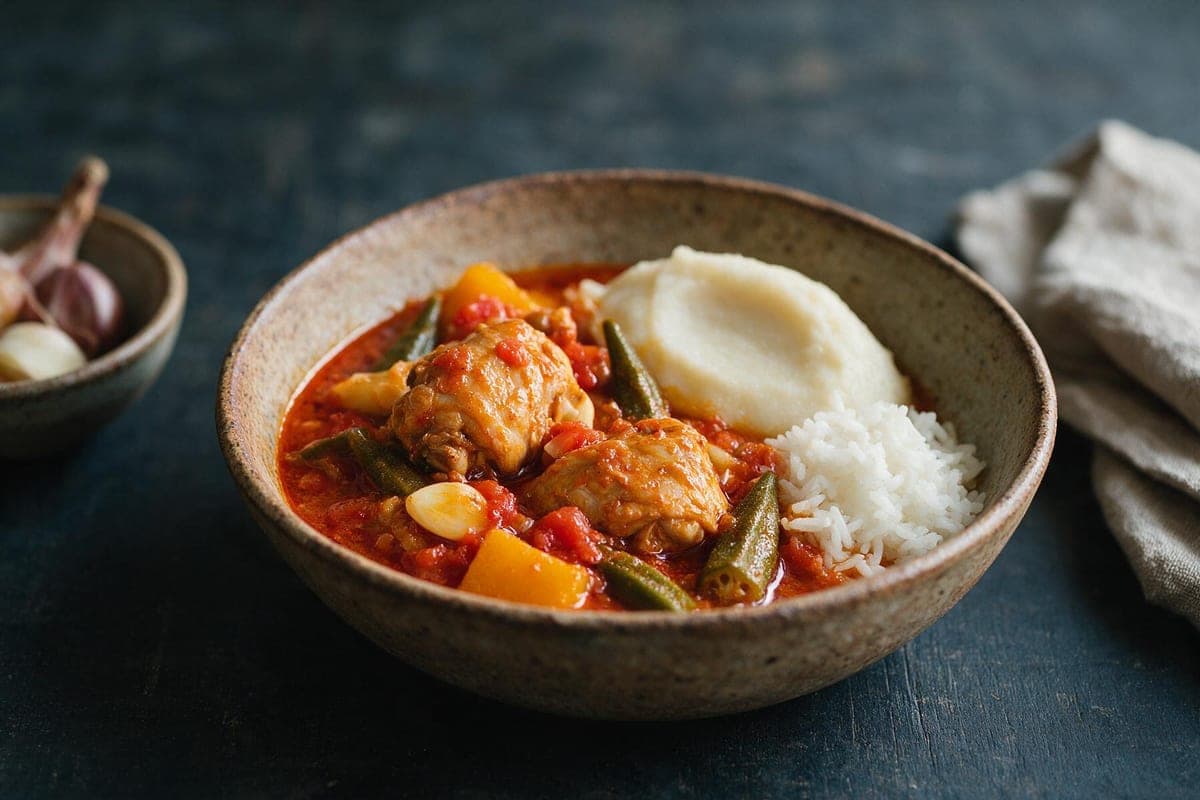
Muamba de Galinha with Funge
Angola's national dish: chicken stewed with red palm oil, tomato, garlic, okra and squash, served with a soft cassava porridge for scooping.

- Prep
- 20 min
- Cook
- 45 min
- Total
- 65 min
- Serves
- 2 adults + 1 child, with stew left over
- Budget
- $17–$27
Muamba de galinha is chicken braised in a sauce colored deep orange by red palm oil, with onion, garlic, tomato, a little chile, and chunks of butternut squash and whole okra pods that soften into the gravy. It tastes earthy and slightly sweet, with a texture that is thicker than a soup and looser than a curry. The traditional partner is funge, a smooth, slightly elastic porridge of cassava flour that you pull off in pieces and dip. The two together are the Angolan Sunday lunch, and with supermarket chicken thighs and a bag of cassava flour they fit a weeknight.
Why it's on our list
Angola is one of the larger holes on our map and this is the dish every source agrees is its national one, so it belongs here even though it is chicken again. What I want to learn is red palm oil: how it tastes, how much to use, and why so much West and Central African cooking is built on it. I also want to try funge, made differently from the maize porridges of the rest of southern Africa, and see whether my son prefers its stretchy texture or the firmer nshima. It is weeknight-feasible because it is one pot and a saucepan, the chicken braises unattended for half an hour, and nothing needs browning in batches.
Field notes · Origin & culture
Muamba de galinha, also spelled moamba, is chicken cooked with palm paste or red palm oil, okra, garlic and often squash, and it is widely considered Angola's national dish along with the funge it is served with. The word muamba is usually explained as the local name for the palm-nut sauce itself, and the dish has a close relative in the Congolese poulet à la moambé. Funge (funje) is cassava flour cooked with water into a gelatinous, grayish porridge; a maize version is common in the south, and it is eaten with fish, pork, chicken or palm-oil beans. Angolan cooking blends Portuguese ingredients, present since the fifteenth century, with Bantu staples, which is why tomato, garlic and bay leaf share the pot with palm oil and cassava.
Noteworthy ingredients
- Red palm oil: The defining ingredient, deep orange, earthy and savory. Look for sustainably certified red palm oil (not the clear, refined kind) in the natural-foods aisle, at African or Brazilian markets, or online. If you cannot find it, use 2 tablespoons neutral oil plus 1 teaspoon paprika for color; the flavor will be milder.
- Cassava flour: Sold as cassava flour or farinha de mandioca in Latin, Caribbean and African markets and in many gluten-free baking aisles. Tapioca starch is not the same thing. If you cannot find it, make the maize version of funge with fine white cornmeal, which is also Angolan.
- Okra: Fresh pods, trimmed and left whole so they stay intact; frozen whole okra works well.
- Butternut squash: Stands in for the pumpkin usually used; a cup and a half of cubes is enough.
Prep — 20 min
- Pat the chicken dry and season with salt, pepper and the juice of half the lemon. Let it sit while you prep.
- Dice the onion. Mince the garlic. Dice the tomatoes. Trim the okra stems without cutting into the pods.
- Measure the cassava flour into a bowl and set it by the stove with a jug of water and a whisk.
- Leave the chile whole; it goes in intact and comes out before serving so it perfumes the sauce without making it hot. If adults want real heat, slice a second chile for the table.
Cook — 45 min
- Warm the palm oil in the Dutch oven over medium heat until it loosens and smells faintly nutty, about 1 minute. Add the onion with a pinch of salt and cook 6 minutes until soft and golden at the edges. Add the garlic and tomato paste and stir 1 minute.
- Add the tomatoes and cook 4 minutes until they slump. Nestle in the chicken skin-side up, add the stock (or bouillon and water), the bay leaf and the whole chile, and bring to a simmer. Cover and cook gently 20 minutes.
- Add the squash cubes, re-cover, and cook 10 minutes. Add the okra, pressing the pods into the sauce, and cook uncovered 10 minutes more, until the okra is tender, the squash yields to a spoon, the chicken is at 165°F and the sauce has thickened and turned glossy orange. Remove the chile and bay leaf. Taste for salt and add a squeeze of lemon.
- Funge, started when the okra goes in: bring 3 cups water to a boil in the medium saucepan. Whisk 1 1/2 cups cassava flour with 1 cup cold water into a smooth slurry. Pour the slurry into the boiling water in a stream, whisking constantly; it will thicken within a minute. Switch to the wooden spoon and beat over medium-low heat 4–5 minutes until the funge is smooth, glossy and elastic, with no raw floury taste. Add a splash of hot water if it seizes. (For the cornmeal version, follow the two-stage method: slurry, then dry meal beaten in.)
Serving
Spoon the funge into a mound on each plate, or into a shared bowl in the middle of the table, and ladle the muamba alongside, giving everyone a thigh, some squash and a few okra pods. Eat by pulling off a piece of funge and dipping it into the sauce. The stew as written is only gently warm from the whole chile, so my son gets exactly what we get; the sliced chile for the adults sits in a saucer. Rice is a fair second starch if someone balks at the funge texture. Leftover muamba keeps three days and is better on day two; funge does not reheat gracefully, so make only as much as you need.