Dinner night · Azerbaijan
Qutab (Azerbaijani Herb- and Meat-Stuffed Flatbreads)
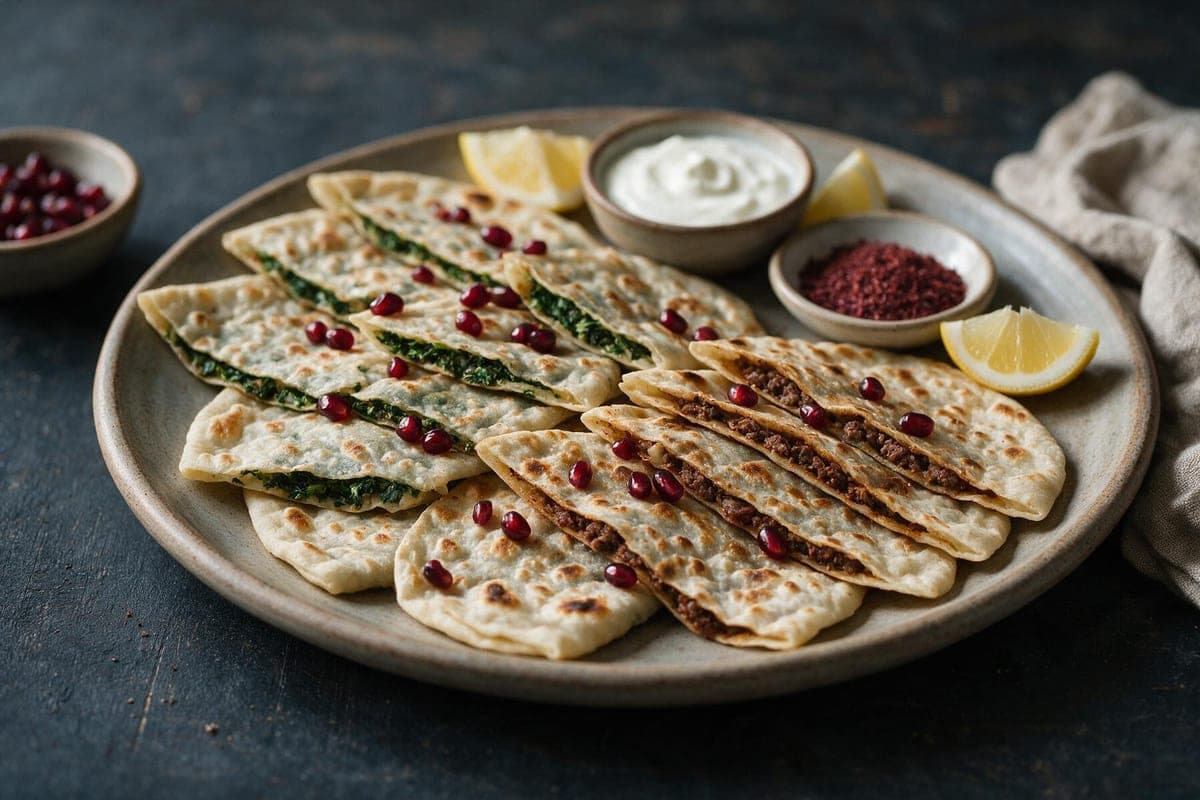
Paper-thin half-moons of dough stuffed with a tangle of fresh herbs or spiced lamb, cooked dry in a hot skillet and served with yogurt and sumac.

- Prep
- 35 min
- Cook
- 25 min
- Total
- 60 min
- Serves
- 2 adults + 1 child, about 10 qutab
- Budget
- $15–$24
Qutab are Azerbaijan's stuffed flatbreads: an unleavened dough rolled nearly see-through, folded over a filling into a half-moon, and cooked on a dry, hot surface until blistered and spotted brown. The two classic fillings are göy qutabı, a heap of chopped fresh herbs and greens with a little onion, and ətli qutab, spiced ground lamb with onion and pomegranate. They come to the table brushed with butter, dusted with sumac, and eaten by hand with thick yogurt. This recipe makes both fillings from one batch of dough, so the dinner is half vegetarian and half not.
Why it's on our list
Azerbaijan sits between the Caucasus, Iran and the Caspian, and its cooking uses more fresh herbs than almost anywhere I know of; qutab puts that habit front and center. I want to learn to roll dough thin enough to see the filling through it, and to cook bread in a skillet with no oil at all, the home stand-in for the domed saj griddle. The fillings take no cooking, the dough is flour, water and salt, and the whole thing is faster than it looks once the rolling rhythm kicks in. There is no heat in the dish, so my son's plate is the same as ours, and the herb version is one of the few genuinely traditional vegetarian dinners in the region.
Field notes · Origin & culture
Qutab (also gutab) is a traditional dish in Azerbaijani cooking, with relatives in Turkish and Turkmen kitchens, made by cooking thin stuffed dough briefly on a convex iron griddle called a saj. Fillings vary by region and season: mixed herbs such as cilantro, dill, spinach, scallion and wild greens; minced lamb with onion and dried pomegranate seeds; pumpkin; cheese; or camel meat in the Caspian-coast village of Jorat, whose qutab are well known. In Baku, qutab is street and cafe food, cooked to order and handed over hot in a paper sleeve with sumac. It is served with qatıq (strained yogurt) and often with narsharab, the thick pomegranate sauce that appears all over Azerbaijani tables. Every household rolls and fills them a little differently.
Noteworthy ingredients
- Fresh herbs in quantity: The herb filling needs a real pile, about 4 cups chopped: cilantro, dill, parsley and scallions, plus spinach for bulk. Do not substitute dried herbs.
- Ground lamb: Richer and more traditional than beef; beef works. Grate the onion so it melts into the lamb as it cooks.
- Sumac: The tart, maroon spice dusted over qutab. Whole Foods, Middle Eastern groceries and spice shops carry it; a squeeze of lemon is the stand-in.
- Pomegranate molasses: A spoonful in the lamb filling gives the sweet-sour note Azerbaijani cooking is known for. Middle Eastern markets carry it; a teaspoon of balsamic plus a pinch of sugar is a rough substitute.
- Thick yogurt: Greek yogurt stands in for qatıq. Stir in a little salt.
Prep — 35 min
- Make the dough: mix 3 cups flour and 1 teaspoon salt, then stir in about 1 cup lukewarm water until a shaggy dough forms. Knead 5 minutes until smooth and firm but pliable, adding a tablespoon of flour or water as needed. Wrap and rest 20 minutes while you make the fillings.
- Herb filling: wash and dry the herbs and spinach well. Pull the leaves and tender stems from the cilantro, dill and parsley, chop everything finely with the spinach and scallions, and put in a bowl with a grind of pepper. Add 1/2 teaspoon salt only when you start filling, since salt draws water from the greens.
- Meat filling: grate the onion on the large holes of a box grater and squeeze out most of its liquid. Mix with the raw ground lamb, pomegranate molasses, 3/4 teaspoon salt and the black pepper. The filling goes in raw and cooks inside the dough, so spread it thin.
- Divide the dough into 10 equal pieces and roll into balls; keep them covered. Stir a pinch of salt into the yogurt and seed the pomegranate if using.
Cook — 25 min
- Heat a large dry cast-iron or heavy nonstick skillet over medium-high heat for 5 minutes. No oil goes in the pan.
- On a floured counter, roll one dough ball into a circle 8–9 inches across and as thin as you can manage, thin enough to see your hand through it. Spread a thin layer of filling over half the circle, leaving a 1/2-inch border: about 1/3 cup herb filling, pressed down, or 3 tablespoons meat filling spread with the back of a spoon. Fold the empty half over, press the edges to seal, and trim with a knife or a plate rim for a neat half-moon.
- Lay the qutab in the hot skillet. Cook 1 1/2–2 minutes until the underside is spotted brown and blistered, then flip and cook 1 1/2–2 minutes more. Meat qutab should go about 30 seconds longer per side; press down with a spatula so the thin layer of lamb cooks through.
- Move to a plate, brush with melted butter, and sprinkle with sumac. Stack and cover with a towel to stay soft and warm. Roll the next one while the current one cooks; after two or three you will find the rhythm.
- Make 5 herb and 5 meat qutab, or whatever split suits the table. Wipe stray flour from the pan between batches so it does not scorch.
Serving
Cut each qutab in half and fan them on a platter, herb and meat side by side, with the bowl of salted yogurt, extra sumac, lemon wedges and pomegranate seeds scattered over the top. Qutab are eaten by hand, folded and dipped. There is nothing spicy to manage, so my son's plate is the same as ours, and the herb ones are a gentle way to get a lot of greens into a child without comment. Leftovers keep two days; reheat in a dry skillet for a minute per side to re-crisp, not in the microwave.