Dinner night · Bhutan
Kewa Datshi with Red Rice
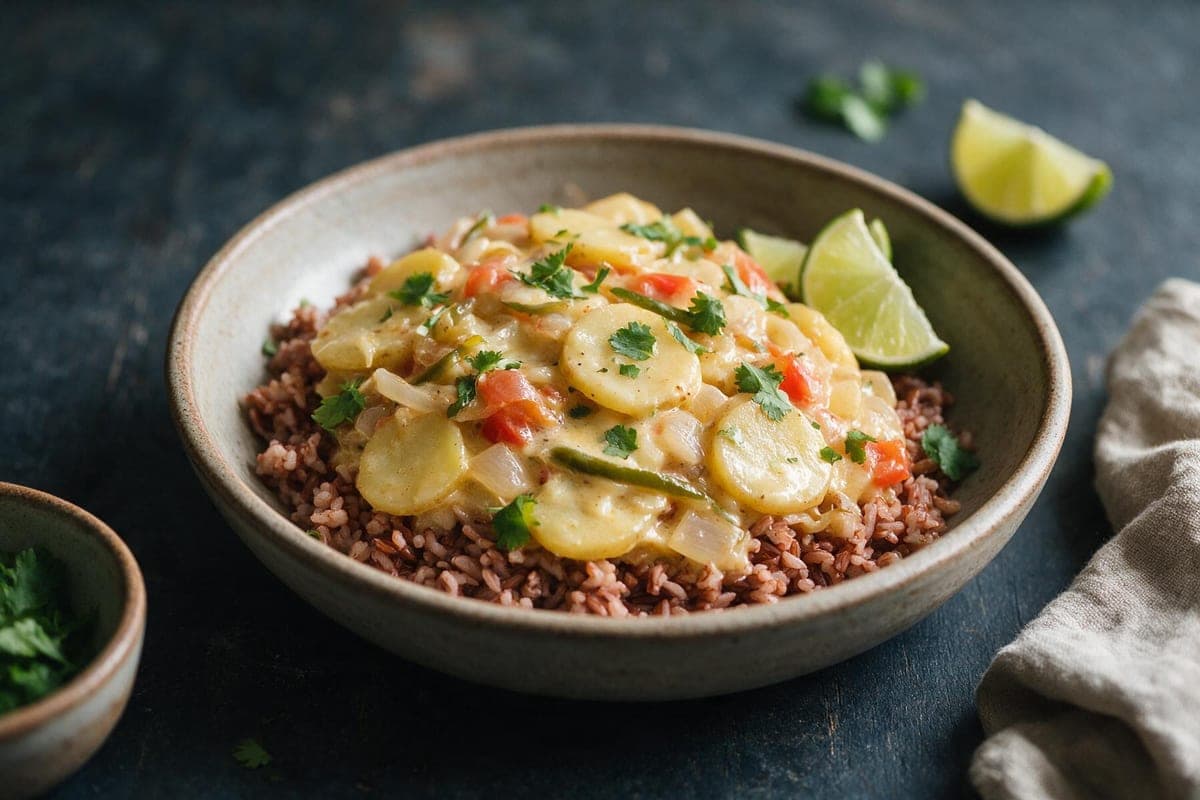
Bhutan's potato-and-cheese stew, the gentler sibling of fiery ema datshi: sliced potatoes simmered with onion, tomato, chile and a melting, salty cheese sauce, spooned over nutty red rice. Vegetarian, done in 45 minutes.

- Prep
- 15 min
- Cook
- 30 min
- Total
- 45 min
- Serves
- 2 adults + 1 child, with rice to spare
- Budget
- $12–$20
Datshi means cheese in Dzongkha, and the datshi dishes of Bhutan are simple stews in which a vegetable is simmered with onion, a little oil and water, then finished with crumbled fresh cheese that melts into a loose, salty sauce. Ema datshi, made with a heap of green chiles, is the national dish and genuinely fiery; kewa datshi swaps most of the chiles for sliced potatoes (kewa), making it the version Bhutanese families serve to children and visitors. It is soft, savory and comforting, somewhere between a potato stew and a fondue, eaten over Bhutanese red rice, a nutty, pink-tinged grain that cooks like brown rice but faster.
Why it's on our list
Bhutan eats chiles as a vegetable rather than a seasoning, and I want a dish from that table that we could actually sit down to; kewa datshi is the honest answer, the mild member of the datshi family rather than a watered-down ema datshi. What I expect to learn is how a fresh, crumbly cheese behaves when melted into a watery stew without flour or cream, and whether the farmer-cheese-and-feta blend really stands in for Bhutanese datshi. It is weeknight-feasible because it is one saucepan plus a rice pot, 45 minutes, and cheap. I'll serve my son's bowl before adding the extra chiles for the adults, and put red rice, a grain none of us has tried, in the middle of the table.
Field notes · Origin & culture
Bhutanese cooking is built on rice, chiles and dairy, and the datshi dishes sit at its center: ema datshi (chile and cheese) is widely described as the national dish, with kewa datshi (potato), shamu datshi (mushroom) and others as everyday variations. The cheese is a soft, fresh farmhouse cheese made from cow's or yak's milk, salty and crumbly rather than aged. Chiles reached the Himalayas from the Americas and are now grown and dried on rooftops across Bhutan; locals eat them in quantities that surprise most visitors. Red rice, a medium-grain variety grown in the high Paro valley and elsewhere, is the traditional staple in much of the country and one of the few Bhutanese foods exported to the US. Meals are several dishes shared around a mound of rice, and datshi is nearly always one of them.
Noteworthy ingredients
- The cheese: Bhutanese datshi is a fresh, salty curd cheese not sold in the US. The closest practical blend is 4 oz farmer cheese or queso fresco for the crumbly body plus 2 oz feta for salt and tang; a little shredded Monterey Jack helps the sauce melt smoothly. Avoid aged cheddar, which clumps.
- Bhutanese red rice: Sold by Lotus Foods at Whole Foods, Trader Joe's and online; it cooks in about 20 minutes and tastes nutty and slightly earthy. Short-grain brown rice is the substitute.
- Chiles: Bhutanese cooks use large, moderately hot green chiles. Here, 2 jalapeños in long strips give a warming stew; add a serrano or two for the adult bowls. Seeding the jalapeños tames the heat further.
- Potatoes: Yukon Gold or red potatoes hold their shape. Slice them thin so they cook in the time.
Prep — 15 min
- Rinse the red rice, combine with 2 1/2 cups water and a pinch of salt, bring to a boil, cover, and simmer on low 20 minutes; rest 5 minutes off the heat, then fluff. (Brown rice needs 40 minutes and 2 3/4 cups water; start it first.)
- Peel the potatoes and slice about 1/4 inch thick, then cut the slices into thick fingers. Keep them in water until needed.
- Halve and slice the onion thin. Chop the tomatoes. Slice the jalapeños lengthwise into strips, seeding them for a milder stew; slice the serranos thin and keep separate. Chop the garlic.
- Crumble the farmer cheese and feta together and mix in the Monterey Jack if using. Chop the cilantro.
Cook — 30 min
- Drain the potatoes and put them in the saucepan with the onion, jalapeño strips, garlic, oil, 1/2 teaspoon salt and 1 1/2 cups water. Bring to a boil, cover, and simmer over medium heat 12–15 minutes, until the potatoes are nearly tender. Bhutanese cooks start everything together in water like this rather than frying first.
- Add the tomatoes and butter and simmer uncovered 5 minutes, until the tomatoes soften and the liquid just covers the bottom of the pan.
- Scatter the cheese over the top, cover, and let it melt over low heat 3–4 minutes without stirring.
- Uncover and stir gently so the cheese becomes a loose sauce coating the potatoes, like a thin, rustic fondue rather than a thick cream. Add a splash of water if it is tight. Taste for salt, remembering the feta is salty, and add black pepper.
- Ladle out the mild portion. Stir half the cilantro and the serranos into the pot for the adults and warm 1 minute more.
Serving
Put a generous scoop of red rice in each bowl and spoon the kewa datshi over or beside it, with plenty of the cheese sauce; Bhutanese families eat this with their hands, pressing rice and stew together, which my son will happily try. Scatter the remaining cilantro and offer lime wedges. The mild bowl is the one ladled out before the serranos went in, and the jalapeño strips can be picked out if even that is too much. Leftovers keep two days; reheat gently with a splash of water, stirring so the cheese loosens rather than tightening.