Dinner night · Cambodia
Fish Amok (Amok Trey)
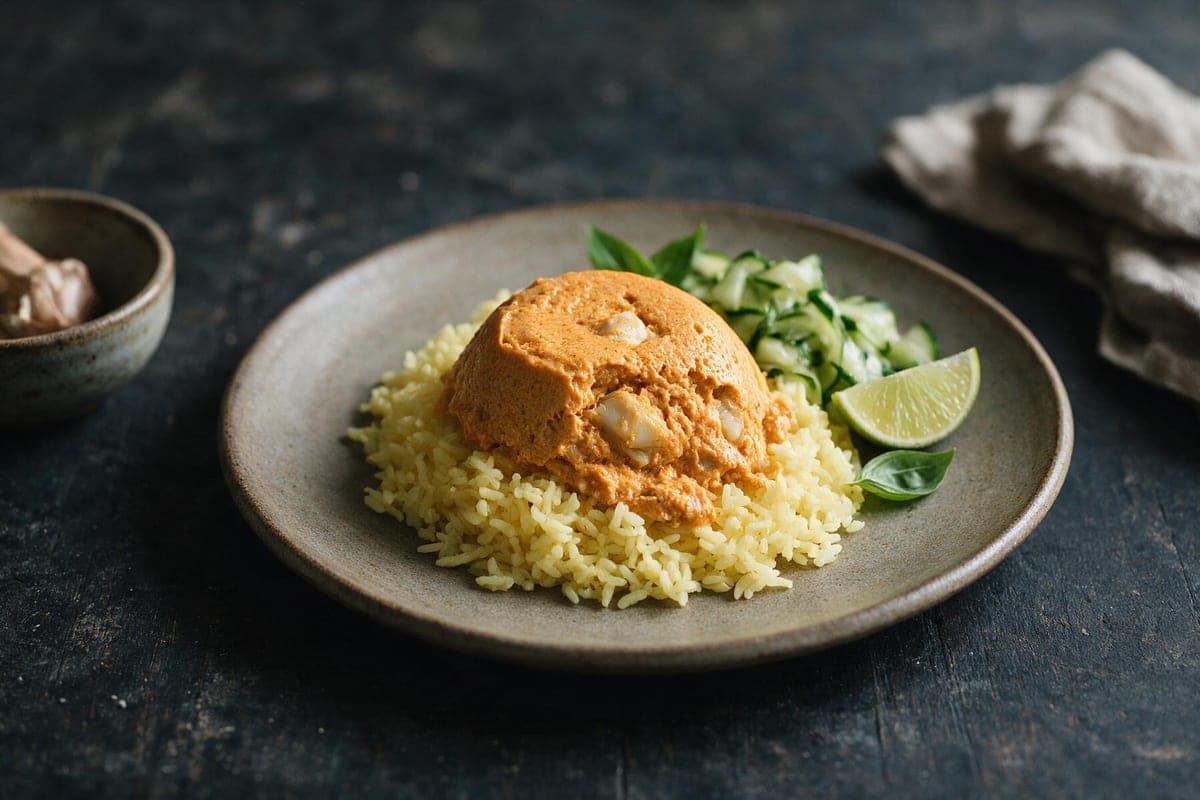
Cambodia's gently spiced coconut-fish curry, set like a soft custard and baked in ramekins instead of banana-leaf cups: fragrant, mild and done in under an hour.

- Prep
- 25 min
- Cook
- 30 min
- Total
- 55 min
- Serves
- 2 adults + 1 child, four ramekins so one is spare
- Budget
- $20–$30
Amok trey is the dish most often named as Cambodia's national one: white fish folded into a thick coconut curry built on kroeung, the Khmer herb paste of lemongrass, galangal, turmeric, garlic and makrut lime, then steamed until it sets into something between a curry and a savory custard. It is aromatic rather than hot; the heat comes from a chile on the side. Traditionally it is steamed in little cups folded from banana leaves over noni leaves. This version blends the paste in a mini processor, uses spinach where noni would go, and bakes the amok in ramekins in a water bath, the same gentle heat without the origami. It is served over jasmine rice with a cucumber salad.
Why it's on our list
I keep seeing amok described as the one dish you must eat in Cambodia, and I want to understand why a curry would be steamed instead of simmered. The technique I expect to learn is the custard set: a beaten egg and thick coconut cream turn a curry into something you can spoon out in soft wedges, and I want to see whether a ramekin in a water bath really stands in for banana leaves. It is weeknight-feasible because the paste takes five minutes, the fish needs no browning, and everything bakes unattended while the rice cooks. Fish is also a protein our map is short on. Because the paste is mild, my son's ramekin should be identical to ours.
Field notes · Origin & culture
Amok is a Khmer dish, and amok trey (fish amok) is its best-known form, though chicken and tofu versions exist. Cambodian sources often trace it to the Khmer Empire era, and steamed coconut-fish curries of this family appear across the region: Thai hor mok and Malay-Indonesian otak-otak are close cousins, so claims about which came first are contested and best left open. The defining element is kroeung, the pounded herb paste at the heart of Khmer cooking, and a leaf of the noni tree (slek nhor) under the fish adds a subtle bitterness most restaurant versions skip. Freshwater fish from the Tonlé Sap is traditional, and the dish is associated with the Water Festival (Bon Om Touk) that marks the river's seasonal reversal. It is served in banana-leaf cups at nearly every restaurant in Phnom Penh and Siem Reap.
Noteworthy ingredients
- Lemongrass and galangal: The soul of kroeung. Use the tender bottom 5 inches of the lemongrass, sliced thin so the processor can break it down. Galangal, a sharper cousin of ginger, is sold fresh or frozen at Asian markets; fresh ginger is an acceptable substitute.
- Makrut lime leaves: Sold frozen at Asian markets; substitute the zest of 1 lime.
- Full-fat coconut milk: The custard needs fat to set. Spoon the thick cream from the top of a second chilled can for the finish.
- Fish sauce: Stands in for the fermented prahok that gives real amok its deep savory floor; prahok is pungent and hard to find, so I am leaving it out and saying so. Check the label if gluten matters.
Prep — 25 min
- Start the rice: rinse 1 1/2 cups jasmine rice, add 1 3/4 cups water and a pinch of salt, and cook according to the package. Heat the oven to 350°F and set a kettle of water to boil for the water bath.
- Make the kroeung: slice the trimmed lemongrass thin, peel and slice the galangal and turmeric, peel the garlic and shallots, and strip the spines from the lime leaves. Blend everything with 2 tablespoons water and 1 teaspoon oil into a fine, slightly wet paste, 2–3 minutes, scraping down the sides.
- Shake the room-temperature can of coconut milk well. Open the chilled can and spoon off about 1/2 cup of the thick cream into a small bowl; save the thin liquid for another use.
- Cut the fish into 1-inch pieces and season lightly with salt. Oil four ramekins and line the bottom of each with a small handful of spinach.
- Thinly slice the cucumber, toss with the rice vinegar, a pinch of salt and a squeeze of lime, and refrigerate. Slice the chile for the adults.
Cook — 30 min
- In a bowl, whisk the kroeung with the shaken can of coconut milk, the egg, fish sauce, palm sugar and shrimp paste if using. Taste: it should be fragrant, salty-sweet and gently sour. Adjust with fish sauce or a squeeze of lime.
- Fold in the fish so each piece is coated. Divide among the four ramekins over the spinach, filling them about three-quarters full.
- Set the ramekins in the roasting pan and pour hot water around them to reach halfway up their sides. Cover the pan loosely with foil.
- Bake 25–30 minutes, until the surface is just set and a knife inserted near the edge comes out clean; the center should still quiver slightly. Lift the foil for the last 5 minutes if the tops look pale.
- Spoon a tablespoon of the reserved coconut cream over each ramekin and return to the oven, uncovered, for 2 minutes. Rest 5 minutes before serving.
Serving
Put a mound of rice on each plate and either set the ramekin beside it or run a knife around the edge and turn the amok out onto the rice; the custard should hold a loose shape and then slump into the grains. Add the cucumber salad, a lime wedge and a few basil leaves. My son's ramekin is the same as ours; the sliced chile and extra fish sauce stay on the table for the adults. Leftover amok keeps two days and reheats gently in a covered ramekin at 300°F.