Dinner night · Canada
Maple-Glazed Salmon with Roasted Vegetables
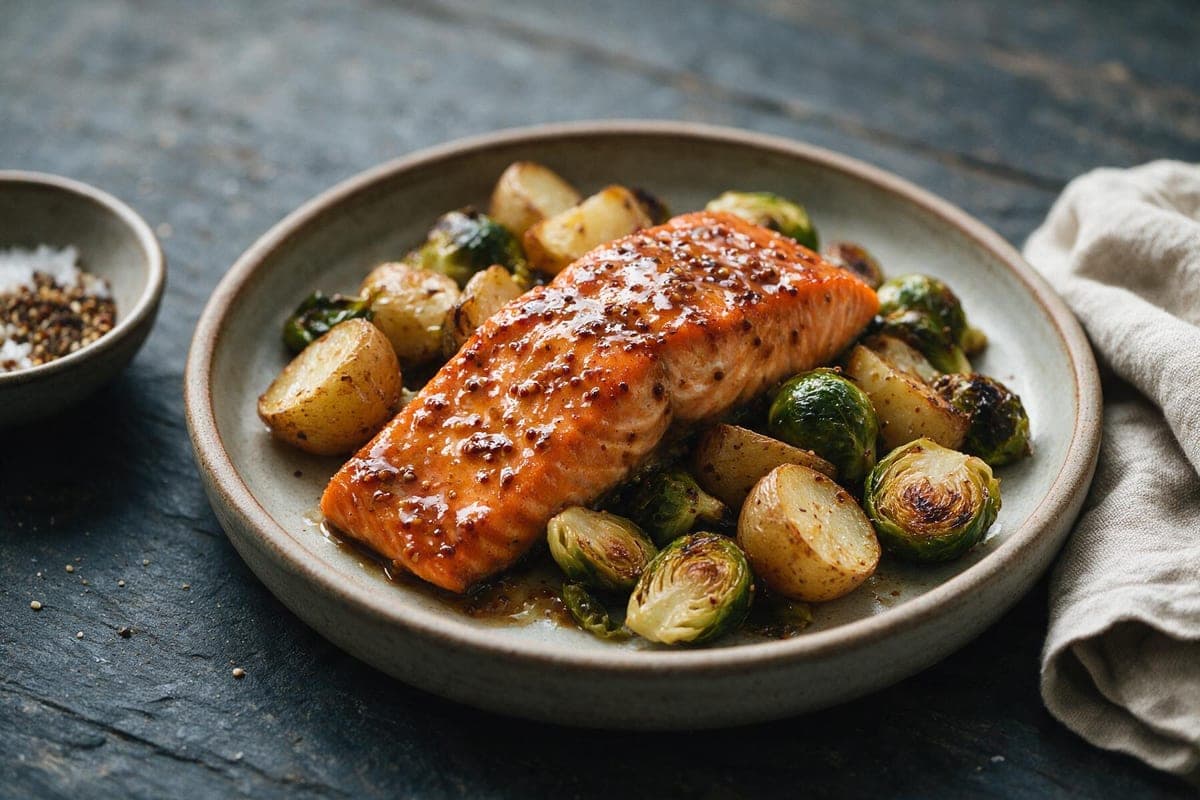
Salmon fillets lacquered with maple syrup and Dijon, roasted on one sheet pan with potatoes and Brussels sprouts: Canada's two great exports on one tray in 40 minutes.
- Prep
- 15 min
- Cook
- 30 min
- Total
- 45 min
- Serves
- 2 adults + 1 child
- Budget
- $22–$32
Salmon fillets are brushed with a glaze of pure maple syrup, Dijon mustard, garlic and lemon, then roasted on the same sheet pan as small potatoes and Brussels sprouts that have had a 20-minute head start. The maple caramelizes at the edges of the fish while the center stays pink and tender, and the vegetables pick up the glaze that drips off. It is a plain, honest dinner, more about good ingredients than technique, done in about 45 minutes with one pan to wash.
Why it's on our list
Canada is the country next door, and that makes it easy to skip; I want it on our map with a dinner that is recognizably Canadian rather than generic North American. Maple syrup is the obvious hook, since Quebec produces most of the world's supply, and salmon from both coasts is a Canadian staple. The thing I want to learn is how to glaze fish without burning the sugar: maple syrup caramelizes fast, so the fish goes in late and the glaze goes on in two coats. It is weeknight-feasible because the vegetables roast unattended while I make the glaze and the fish needs just 12 minutes. There is no chile and nothing unfamiliar, so I expect my son's plate to be the same as ours.
Field notes · Origin & culture
Maple syrup is made by boiling down the sap of sugar maples tapped in late winter, a practice Indigenous peoples of northeastern North America developed long before European settlement and taught to French colonists in the seventeenth century. Quebec now produces roughly 70 percent of the world's supply, and the sugar-shack (cabane à sucre) spring meal is a cultural fixture there. Salmon is equally rooted: Pacific salmon has been central to Indigenous foodways in British Columbia for millennia, and Atlantic salmon is farmed and fished in the Maritimes. Pairing the two is a modern Canadian restaurant habit rather than a single traditional recipe, so this is a dish of the country's ingredients rather than a named classic, and I would not claim otherwise.
Noteworthy ingredients
- Pure maple syrup: It has to be the real thing, not pancake syrup, which is corn syrup with flavoring and will not caramelize the same way. Grade A "dark, robust" has the most maple flavor for glazing; "amber" is fine too. Any supermarket carries it.
- Salmon fillets: Skin-on, center-cut pieces about 1 inch thick cook most evenly. Farmed Atlantic is the usual supermarket option; wild sockeye is thinner and leaner, so pull it 2–3 minutes sooner.
- Dijon mustard: It keeps the glaze from being one-note sweet and helps it cling to the fish. Whole-grain Dijon works and looks nice.
- Brussels sprouts and small potatoes: Both roast well at high heat. Halved baby potatoes need no peeling; green beans or carrot chunks can replace the sprouts.
Prep — 15 min
- Heat the oven to 425°F with a rack in the upper-middle position. Line a large rimmed sheet pan with foil or parchment; the glaze will drip and this saves scrubbing.
- Halve the potatoes (quarter any larger than a golf ball). Trim the Brussels sprouts and halve them through the stem. Toss both with 2 tablespoons olive oil, 3/4 teaspoon salt and some pepper, and spread them on the pan cut-side down, leaving a bare strip down the middle for the fish.
- Make the glaze: whisk the maple syrup, Dijon, 1 minced garlic clove, 1 tablespoon lemon juice, the soy sauce if using, and a pinch of salt in a small bowl. If you want it thicker, simmer it in a small saucepan for 2–3 minutes until it coats a spoon, then cool slightly.
- Pat the salmon dry, rub with the remaining tablespoon of oil, and season with salt and pepper. Set aside at room temperature.
Cook — 30 min
- Roast the vegetables for 18–20 minutes, until the potatoes are getting tender and the sprouts are browning at the edges. Pull the pan out and turn the pieces over.
- Lay the salmon skin-side down in the clear strip in the middle of the pan. Brush each piece generously with glaze, using about half of it.
- Return the pan to the oven for 6 minutes. Pull it out, brush the salmon with most of the remaining glaze, and roast 5–7 minutes more, until the fish flakes at the thickest part and reads 125–130°F for a moist, just-opaque center (a few degrees higher if your family prefers it cooked through). Watch the last minutes closely; maple scorches once it goes past deep amber.
- Rest the pan 2 minutes. Squeeze the other half of the lemon over the vegetables and scatter on the thyme or dill if using.
Serving
Slide a spatula between the skin and the flesh if anyone does not want the skin; it usually stays behind on the foil. Plate a piece of salmon with a scoop of potatoes and sprouts, drizzle any leftover glaze over the fish, and put lemon wedges on the table. There is nothing here to keep mild; my son's plate is the same as ours, and if he is skeptical of Brussels sprouts I will offer him the crispiest, most maple-touched ones first. Leftover salmon is good cold the next day flaked into a salad; the vegetables reheat well in a hot skillet.