Dinner night · Central African Republic
Kanda ti Nyma (Central African Meatballs)
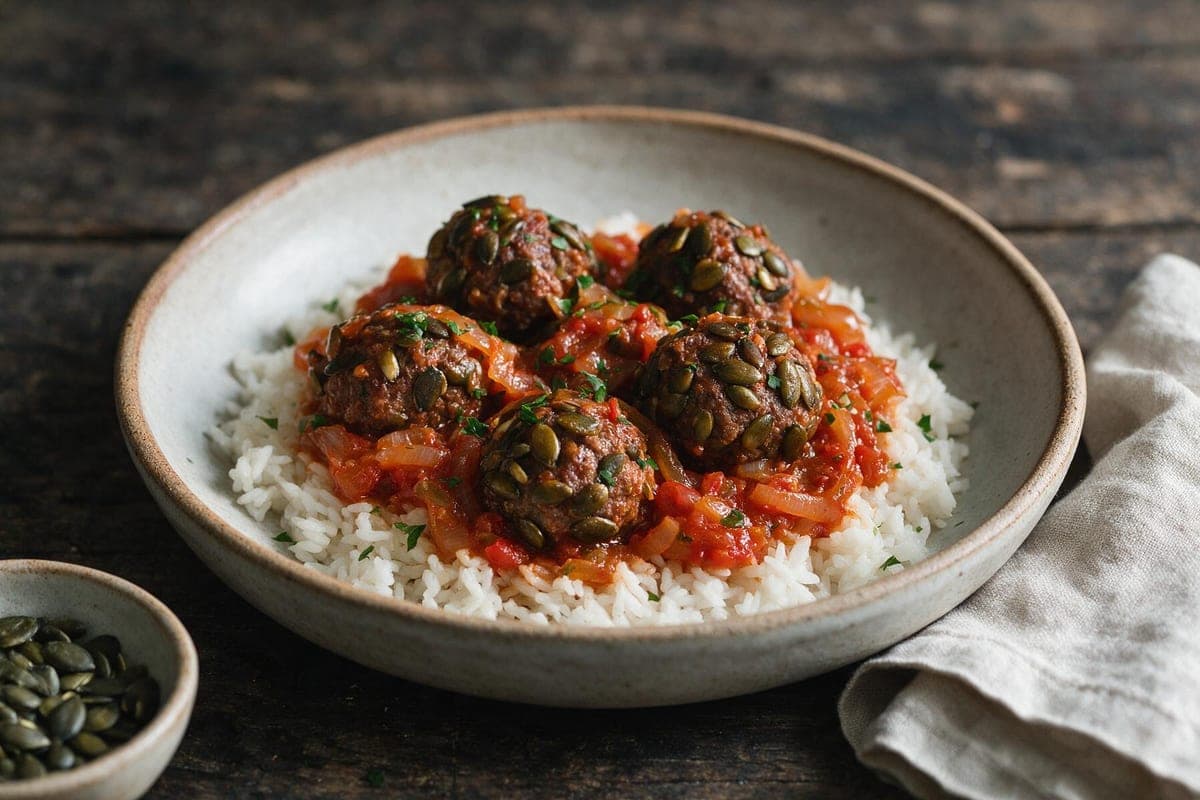
Beef meatballs bound with ground pumpkin seeds, simmered in a tomato, onion and chile sauce and served over rice: the Central African Republic's best-known dish.

- Prep
- 25 min
- Cook
- 35 min
- Total
- 60 min
- Serves
- 2 adults + 1 child, about 15 meatballs
- Budget
- $16–$24
Kanda are the meatballs of the Central African Republic, and kanda ti nyma, roughly "kanda of meat" in Sango, is the beef version: ground beef mixed with nearly as much toasted, finely ground pumpkin seed, plus onion, garlic and herbs, rolled into golf balls and simmered in tomato sauce until it thickens around them. The pumpkin seeds are the whole idea: they bind the meat without bread or egg, keep the meatballs tender, and give them a nutty, faintly green flavor unlike any Italian or Swedish meatball. The sauce is simple, onion, tomato and a chile, and the dish is eaten over plain white rice.
Why it's on our list
The Central African Republic is one of the least-documented cuisines on our map, and I would rather cook the one dish nearly every source agrees on than guess at something fancier. Kanda is that dish. I want to learn the seed-binder technique: ground pumpkin seeds standing in for breadcrumbs is a Central African idea (egusi plays a similar role in Cameroon and Nigeria), and it makes a naturally gluten-free meatball with a texture I have not tasted. It is weeknight-feasible because meatballs plus a quick tomato sauce is a format we already know; the only new step is toasting and grinding the seeds, five minutes with a bag of pepitas from the baking aisle. The chile goes in whole, so the sauce stays mild for my son and the heat is the adults' decision.
Field notes · Origin & culture
The Central African Republic's everyday food is built on cassava, eaten as gozo (a stiff cassava-flour paste) or chikwangue, with sauces of cassava leaves (ngunza or ngoundja), peanuts, palm oil, okra and the wild forest leaf koko, plus river fish and, seasonally, caterpillars. Wikipedia describes kanda ti nyma as "spicy meatballs made with beef" and lists it among the country's signature dishes; recipe sources describe the classic kanda as ground beef bound with ground pumpkin seeds in tomato sauce, and note that salt was historically scarce and expensive in the region, which is why many local recipes use little of it. Kanda is a family of dishes rather than a single recipe: there are versions with okra and peanuts, and kanda made from cassava leaves (kanda ngoundja). Sango, the national language, gives the dish its name. This is the beef-and-pumpkin-seed version most often shared by Central African cooks.
Noteworthy ingredients
- Raw pumpkin seeds (pepitas): The hulled green kind, in the baking or snack aisle. Toast lightly and grind to a fine meal; they replace breadcrumbs and egg entirely.
- Ground beef, 85 percent lean: Leaner beef makes dry meatballs, since there is no bread to hold moisture. With 90 percent, add a tablespoon of oil to the mix.
- Tomato paste plus fresh tomatoes: The sauce is thin and bright compared with an Italian ragù; the paste gives color and body without a long simmer.
- A whole habanero: Simmered unbroken for perfume; chopped only if you want the dish properly spicy, as it is often served.
- Fresh parsley: Recipes consistently call for parsley in the meat, which keeps the pumpkin-seed flavor fresh rather than heavy.
Prep — 25 min
- Toast the pumpkin seeds in a dry skillet over medium heat, stirring, 4–5 minutes until they puff and smell nutty. Cool 5 minutes, then grind in a food processor or spice grinder to a fine, slightly sandy meal; stop before it turns to paste.
- Finely dice one onion; set half aside for the sauce. Mince 2 garlic cloves for the meat and 2 for the sauce. Chop 1/2 cup parsley.
- Combine the beef, 1 cup of the ground pumpkin seeds, half the diced onion, the garlic for the meat, the parsley, 3/4 teaspoon salt and 1/2 teaspoon black pepper. Add 3 tablespoons cold water and mix by hand until it holds together like a soft dough. Roll into 15 golf-ball-sized meatballs and chill 10 minutes while you make the sauce.
- Slice the second onion thin. Chop the tomatoes, or drain the can. Dissolve the bouillon cube in 1 1/2 cups hot water.
- Start the rice: rinse 1 1/2 cups rice and cook with 2 1/4 cups water and a pinch of salt by the package timing.
Cook — 35 min
- Heat the oil in the skillet over medium heat. Add the sliced onion and the reserved diced onion with a pinch of salt and cook 6 minutes until soft and golden. Add the remaining garlic and the tomato paste and stir 1 minute.
- Add the tomatoes and cook 5 minutes until they soften and the sauce thickens slightly. Pour in the bouillon water, add the whole chile, and bring to a boil.
- Lower the meatballs into the sauce in one layer. Let it return to a strong simmer for 3 minutes, then reduce to medium, cover, and cook 10 minutes.
- Uncover, turn the meatballs gently, and simmer 12–15 minutes more until the sauce has reduced to a thick coating and the meatballs are firm and cooked through (160°F). Shake the pan rather than stirring so they stay whole.
- Stir the remaining 1/4 cup ground pumpkin seeds into the sauce and simmer 2 minutes to thicken. Remove the chile. Season with salt, black pepper and a squeeze of lemon.
Serving
Spoon rice onto each plate and set the meatballs on top with plenty of sauce, finishing with chopped parsley; in Bangui the starch would often be gozo, the cassava paste, but white rice is the usual stand-in. The sauce as written is gently warm, so my son's plate is the same as ours, and the softened chile sits on a saucer for anyone who wants to mash some in. Leftover kanda keep three days and reheat well in their sauce; they are also good cold in a sandwich.