Dinner night · Chile
Pastel de Choclo
Chile's corn-and-beef bake: a cumin-scented ground beef "pino" with olives, raisins and hard-boiled egg under a sweet, basil-flecked corn crust that browns in the oven.
- Prep
- 25 min
- Cook
- 50 min
- Total
- 75 min
- Serves
- 2 adults + 1 child, with leftovers
- Budget
- $16–$24
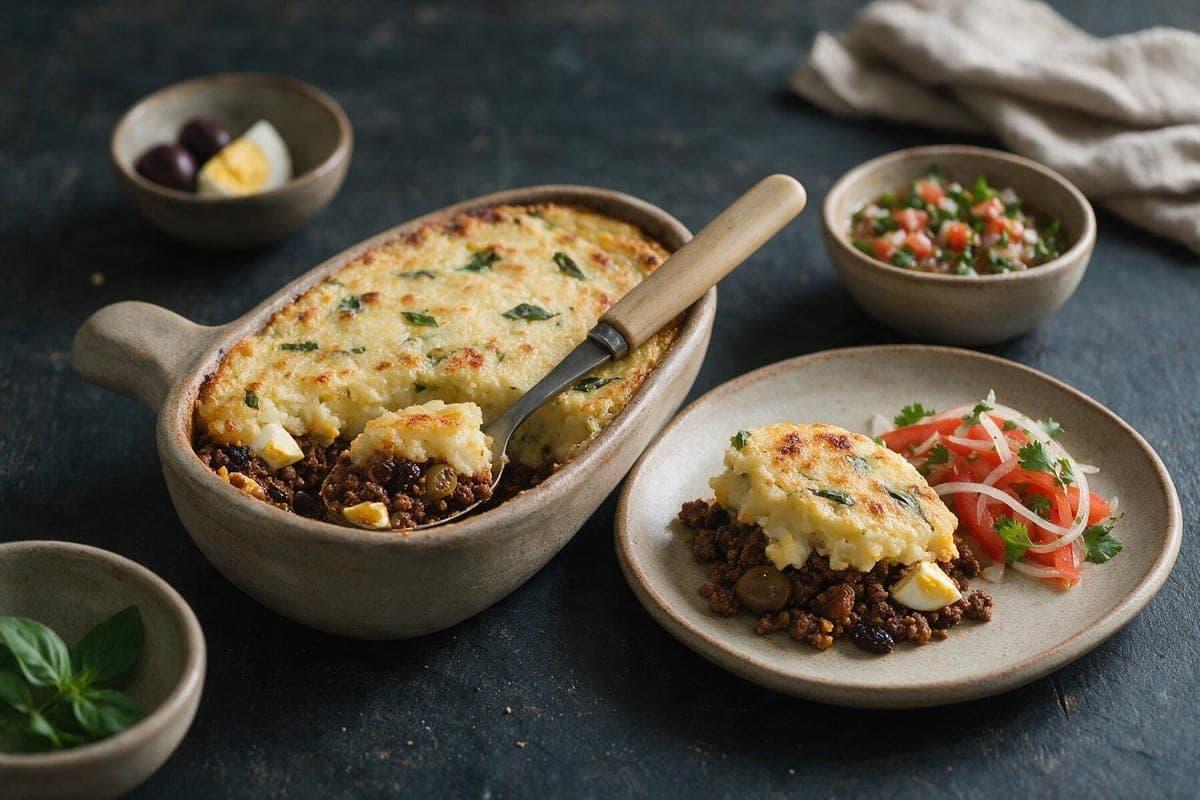
Pastel de choclo is a baked dish in two layers. The bottom is pino, ground beef cooked slowly with a lot of onion, cumin, paprika and oregano, studded with raisins, black olives and slices of hard-boiled egg. The top is a thick purée of sweet corn and basil, cooked with milk and butter until it holds its shape, spread over the meat and sprinkled with sugar so it browns in a hot oven. The sweet-savory contrast is the whole idea, and it is one of the dishes Chileans most readily call their own.
Why it's on our list
I want a South American dish that is not a steak or a stew, and this one has a construction I have never tried: a corn purée used like the mashed potato on a shepherd's pie. The techniques to learn are the slow-cooked pino, which is also the filling of Chilean empanadas, and getting the corn layer thick enough to brown rather than slide. It is weeknight-feasible with frozen corn and a blender; the pino takes 20 minutes and the oven does the rest. There is no chile heat at all, so my son's portion needs no adjustment, and I expect the raisins and sweet corn top to make him curious rather than wary.
Field notes · Origin & culture
Pastel de choclo is a dish of central Chile, traditionally baked in a shallow clay dish called a paila de greda and eaten in summer when fresh corn (choclo, from Quechua) is in season. Its history is usually told as a colonial-era meeting of ingredients: corn, basil and the clay dish from Indigenous Mapuche and Andean cooking; beef, onion, olives, raisins and cumin from Spain. Chilean anthropologist Sonia Montecino has traced it to Indigenous cooks in colonial Spanish kitchens, though some food historians point to similar layered corn dishes in Peru, and a single origin is not settled. The pino filling is shared with Chile's empanadas; many recipes also layer in chicken on the bone, which this weeknight version omits. The sugar on top is not optional for most Chileans.
Noteworthy ingredients
- Corn: Chilean choclo is a large, starchy field corn, far less sweet than US sweet corn. Frozen sweet corn is the practical substitute; the purée will be sweeter, so hold back on the sugar topping if you prefer. Fresh corn from 4–5 ears works in summer.
- Fresh basil: It goes into the corn layer, not the meat, and is the flavor people miss when it is left out.
- Raisins and black olives: The sweet and salty surprises in the pino. Pitted California black olives are closest to what Chilean home cooks use; Kalamata are stronger but fine.
- Cumin and paprika: Chilean ají de color is a mild sweet paprika; ordinary sweet paprika stands in. Cumin should be noticeable.
Prep — 25 min
- Put 2 eggs in a small saucepan, cover with cold water, bring to a boil, then cook 9 minutes. Cool in cold water, peel and slice into rounds.
- Soak the raisins in warm water so they plump. Halve the olives.
- Dice the onions finely; this is a lot of onion and that is correct. Mince the garlic. Strip the basil leaves (about 1 cup, loosely packed).
- Thaw the corn in a colander under warm water and drain well. Heat the oven to 400°F and butter the baking dish.
Cook — 50 min
- Heat the oil in a large skillet over medium heat. Add the onions with 1/2 teaspoon salt and cook 10–12 minutes, stirring often, until soft and golden; do not rush this.
- Add the garlic, cumin, paprika and oregano and stir 1 minute. Raise the heat to medium-high, add the beef, and cook, breaking it up, until no pink remains and the liquid has mostly evaporated, 6–8 minutes. Season with salt and pepper, stir in the drained raisins, and take the pan off the heat.
- While the onions cook, make the corn layer: blend the corn, milk and basil until mostly smooth. Pour into a saucepan with the butter, 1/2 teaspoon salt and the cornstarch whisked into 2 tablespoons water. Cook over medium heat, stirring constantly, 6–8 minutes, until it thickens to a soft mashed-potato consistency.
- Spread the pino in the baking dish. Lay the egg slices over it and scatter the olives. Spoon the corn mixture on top, spread it to the edges to seal the filling in, and sprinkle the sugar evenly over the surface.
- Bake 30–35 minutes, until the top is set and spotted deep golden brown; if pale, give it 2–3 minutes under the broiler, watching closely. Rest 10 minutes before serving; it firms up as it sits.
Serving
Spoon pastel de choclo straight from the dish onto plates, making sure each portion has both layers and some of the browned top. In Chile it is often served with ensalada chilena (sliced tomato, thin onion, cilantro, oil and salt) and a dish of pebre, the Chilean salsa of cilantro, onion, tomato and chile; pebre is where the heat lives, so it stays on the table. The dish itself is mild and gently sweet, so my son's plate is the same as ours, olives included unless he lobbies otherwise. Leftovers keep three days and reheat well at 350°F, covered with foil for the first 15 minutes.