Dinner night · Denmark
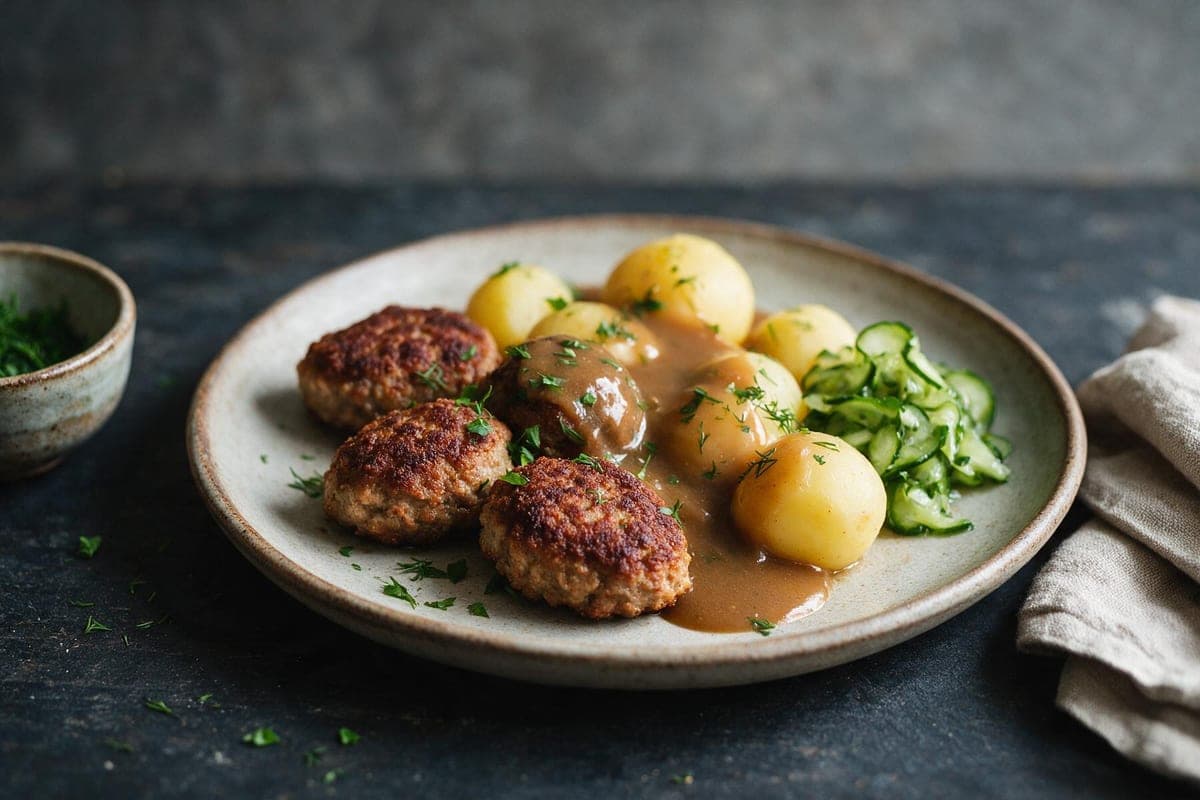
Frikadeller with Brown Gravy and Potatoes
Denmark's soft, spoon-shaped pork meatballs fried in butter, with boiled potatoes, brown gravy and a quick pickled cucumber salad, in about 45 minutes.

- Prep
- 20 min
- Cook
- 25 min
- Total
- 45 min
- Serves
- 2 adults + 1 child, with 3–4 meatballs left for lunch sandwiches
- Budget
- $15–$22
Frikadeller are Danish meatballs, but flatter and softer than the Italian or Swedish kind: ground pork (often mixed with veal) is beaten with grated onion, egg, flour and milk into a loose, almost spreadable mixture, shaped into ovals with a spoon, and fried slowly in butter until deep brown outside and tender inside. They are served with boiled potatoes, brun sovs (brown gravy), and something sharp on the side: pickled red cabbage or a sweet-sour cucumber salad. It is a plain plate and, by reputation, one of Denmark's best-loved dinners.
Why it's on our list
Denmark needs a dinner on our map, and this is the dish Danes call their national one. I want to learn what makes a frikadelle different from the meatballs I already know: the loose mixture, the spoon shaping, the gentle fry in butter instead of a hot sear. I am also curious whether homemade brun sovs beats the packet Danes often use. Meatballs and potatoes are already a favorite with my son, so this is a comfortable entry point for a cuisine he has never tasted, and it comes together in one skillet and one pot in under an hour.
Field notes · Origin & culture
Frikadeller are often described as Denmark's national dish, though Danish sources are careful to note that similar fried meat patties exist across northern and central Europe, from German Frikadellen to Swedish köttbullar. According to the Danish encyclopedia Lex, they appear in Danish cooking from the nineteenth century, when hand-mincing meat made them a labor-intensive dish for better-off households; the mechanical meat grinder later in that century made minced meat cheap and moved frikadeller into husmandskost, everyday Danish home food. They are eaten hot with potatoes and gravy, cold on rye bread as smørrebrød, and in lunchboxes nationwide. Pickled red cabbage (rødkål) and brown gravy (brun sovs) are the classic companions; the sweet-sour cucumber salad (agurkesalat) we make here is the other traditional choice and is faster.
Noteworthy ingredients
- Ground pork: Fatty supermarket ground pork (not lean) gives tender frikadeller. The classic Danish blend is half pork, half veal; mixing in ground beef is a common home shortcut and works fine.
- Grated onion: Grated rather than chopped, so it dissolves into the meat and keeps it moist.
- Flour and milk: They loosen the mixture; a proper frikadelle batter is too soft to roll by hand, which is why Danes shape them with a spoon.
- Butter: Frying in plenty of butter over medium heat gives the characteristic dark, even crust. Half butter, half oil guards against burning. Jarred pickled red cabbage (Rotkohl, international aisle) is the authentic shortcut if you skip the cucumber salad.
Prep — 20 min
- Cucumber salad first so it has time to pickle: slice the cucumber as thin as you can (a mandoline helps), toss with 1/2 teaspoon salt and let it sit 10 minutes, then squeeze out the water. Whisk the vinegar with 3 tablespoons sugar, 2 tablespoons water and a little pepper, pour over the cucumber, and refrigerate.
- Scrub the potatoes and put them in a pot of cold salted water.
- Grate the onion on the large holes of a box grater. In a bowl, mix the pork, onion, egg, 3 tablespoons flour, 1 1/4 teaspoons salt, 1/2 teaspoon pepper and a pinch of allspice. Add the milk a little at a time, stirring hard with a wooden spoon, until the mixture is soft and sticky but holds a mound; it should be looser than American meatball mix. Rest it in the fridge 10 minutes.
- Chop the parsley or dill.
Cook — 25 min
- Bring the potatoes to a boil and simmer 15–20 minutes until a knife slides in easily. Drain and keep warm under a towel.
- Heat 2 tablespoons butter and the oil in a large skillet over medium heat until the butter foams. Dip a tablespoon in the hot fat, scoop a heaping spoonful of the meat mixture, and shape it against the side of the bowl into an oval; slide it into the pan. Repeat, leaving space; you should get 10–12 frikadeller, cooked in two batches if needed.
- Fry 5–6 minutes per side without crowding or poking, until deeply browned and cooked through (160°F in the center). Lower the heat if the butter darkens too fast. Move to a plate and tent with foil. Leave the browned butter and drippings in the pan.
- Brown gravy: add the remaining 2 tablespoons butter to the skillet over medium heat, whisk in 2 tablespoons flour, and cook, stirring, 2–3 minutes until it smells toasty and turns the color of peanut butter. Whisk in the stock gradually, scraping up the browned bits, and simmer 3–4 minutes until it thickens. Add the soy sauce for color, and salt and pepper to taste. A splash of milk or cream at the end is common in Denmark and softens the gravy.
Serving
Give each plate three or four frikadeller, a few potatoes, a generous spoon of gravy over both, and a pile of cucumber salad or red cabbage on the side; a sprinkle of parsley or dill finishes it. Everything here is mild, so my son's plate is the same as ours, with the cucumber salad in a separate bowl in case the vinegar is too sharp for him. Leftover frikadeller are a Danish lunch staple, eaten cold on buttered rye bread with mustard; they keep three days, and the gravy reheats with a splash of stock.