Dinner night · Egypt
Koshari
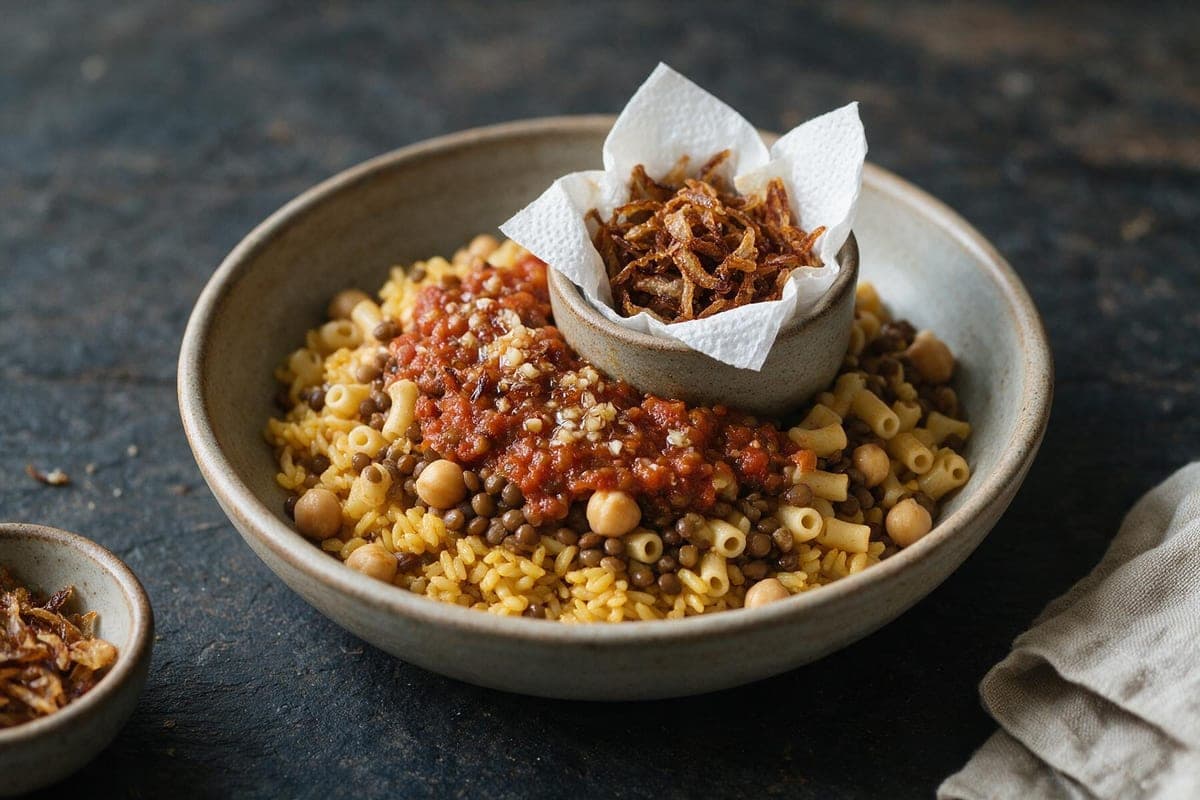
Egypt's beloved street-food bowl of rice, lentils, macaroni and chickpeas under spiced tomato sauce, crispy onions and a sharp garlic-vinegar dressing.

- Prep
- 15 min
- Cook
- 40 min
- Total
- 55 min
- Serves
- 2 adults + 1 child, with generous leftovers; koshari is hard to make small
- Budget
- $10–$16
Koshari (also spelled koshary or kushari) is Egypt's national dish and its great carbohydrate layer cake: rice cooked with toasted vermicelli, brown lentils, small macaroni and chickpeas piled in a bowl, then dressed with a cumin-scented tomato sauce, a spoon of da'a (a sharp garlic-vinegar sauce), a spoon of shatta (chile sauce) for those who want it, and a big handful of crispy fried onions. Nothing in it is expensive or hard to find, and it is entirely plant-based without feeling like a compromise. In Egypt it is served from huge pots at counters where the server builds each bowl in seconds.
Why it's on our list
Our map is heavy on chicken, and koshari is proof that a vegetarian dinner can be the hearty, crowd-pleasing kind. I want to learn the assembly logic of a dish built from four cheap starches and three condiments, where texture and contrast do the work: soft lentils, chewy pasta, crunchy onions, sour vinegar. It is weeknight-feasible because the components cook in parallel on four burners, and the crispy onions, the only step that needs attention, take ten minutes. Each person dresses their own bowl, so my son can have his plain with onions and a little tomato sauce while the adults go heavy on garlic-vinegar and chile.
Field notes · Origin & culture
Koshari is eaten across Egypt, especially in Cairo, where dedicated koshari restaurants serve nothing else, and it is widely regarded as the national dish. Its origins are debated: a popular story claims a link to the ancient Egyptian pantry, but historians have not found evidence for it, and the mix of rice, lentils and pasta is more plausibly a nineteenth-century creation, with the lentils-and-rice idea often compared to Indian khichdi and the pasta reflecting the Italian community in Egypt at the time. The earliest known Western description, by the explorer Richard Burton in 1853, called it a breakfast of the people of Suez. It became a workers' food before moving into restaurants, and in late 2025 it was added to UNESCO's list of intangible cultural heritage.
Noteworthy ingredients
- Brown or green lentils: They hold their shape, which matters in a layered bowl. Red lentils collapse into mush.
- Small macaroni (ditalini or elbows): Egyptian koshari uses short tube pasta; any small shape works.
- Vermicelli or fideo: Toasted in oil before the rice goes in, it gives the rice golden flecks and a nutty flavor. Angel hair broken into inch pieces is the substitute.
- Distilled white vinegar and garlic: The da'a sauce is just garlic, vinegar, cumin, lemon and water, and it is what keeps all those starches from tasting heavy. Do not skip it.
Prep — 15 min
- Halve and very thinly slice 2 of the onions. Toss with a pinch of salt and let them sit 10 minutes, then pat dry and toss with the flour or cornstarch; this makes them crisp.
- Finely dice the third onion for the tomato sauce. Mince 4 garlic cloves for the sauce and grate the other 2 for the da'a.
- Rinse the lentils and the rice separately. Rinse and drain the chickpeas.
- Make the da'a: whisk the grated garlic with the vinegar, 1/4 cup water, the juice of half the lemon, 1 teaspoon cumin and 1/2 teaspoon salt. Set aside.
- Put a large pot of salted water on to boil for the macaroni.
Cook — 40 min
- Lentils: cover with 3 cups water, bring to a boil, then simmer 20–25 minutes until tender but intact. Drain, season with salt and 1/2 teaspoon cumin.
- Rice: heat 1 tablespoon oil in a saucepan, add the vermicelli and stir 2 minutes until golden brown. Add the rice, stir to coat, add 2 1/4 cups water and 1 teaspoon salt. Bring to a boil, cover, lower the heat and cook 15 minutes; rest 5 minutes off heat.
- Tomato sauce: heat 2 tablespoons oil in a small saucepan, cook the diced onion 5 minutes, add the minced garlic, tomato paste, 1/2 teaspoon cumin and the coriander; cook 1 minute. Add the crushed tomatoes, 1/2 cup water, 2 tablespoons of the vinegar and salt to taste. Simmer 15 minutes. Ladle a cup into a small bowl and stir in the chile flakes or harissa to make the shatta for the adults.
- Macaroni: cook in the boiling water until just done, drain, toss with a teaspoon of oil.
- Crispy onions: heat 1 cup oil in a skillet over medium-high heat. Fry the floured onions in two batches, stirring, 5–7 minutes per batch until deep golden; lift out onto paper towels and salt immediately. They darken after leaving the oil, so pull them a shade early.
- Warm the chickpeas in a small pan with a spoonful of their liquid.
Serving
Build each bowl in layers: rice first, then lentils, then macaroni, then a few spoonfuls of chickpeas, a ladle of tomato sauce and a big handful of crispy onions, with the da'a and the shatta on the table so everyone finishes their own. I plan to give my son a bowl of rice, lentils, pasta and onions with a little plain tomato sauce and let him taste the da'a from a spoon before committing; the adult bowls get both sauces. Leftovers are the whole point: store the components separately in the fridge for up to four days and reheat the starches with a splash of water. The onions keep crisp in a paper-towel-lined container for a day.