Dinner night · Eswatini
Sishwala with Beef and Cabbage Stew
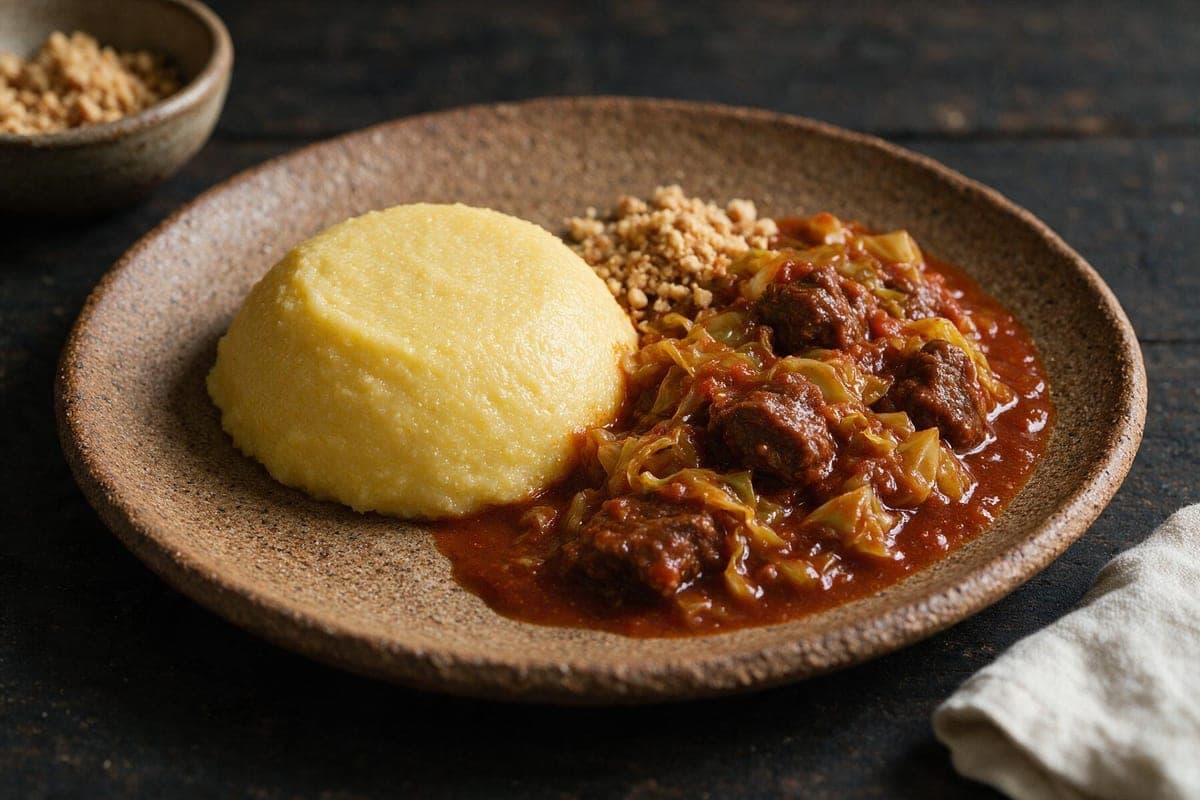
Eswatini's everyday maize porridge with a tomato-rich beef stew finished with cabbage and a spoon of ground peanuts, a nod to the Swazi sidlwadlwa.

- Prep
- 15 min
- Cook
- 55 min
- Total
- 70 min
- Serves
- 2 adults + 1 child, with a bowl of stew left over
- Budget
- $16–$25
This is the plate that Swazi homesteads eat most nights: a stiff, smooth maize porridge called sishwala, and a stew to eat it with. The stew here is beef chuck browned and simmered with onion, tomato and a little curry powder until tender, then finished with shredded cabbage and a spoonful of ground peanuts that thicken the gravy and give it a gentle, nutty sweetness. Beef, cabbage and peanuts together is the combination in sidlwadlwa, a Swazi meat stew, and I have borrowed it. There is no chile; the flavor is savory and plain in the best way, and everything goes onto the plate to be eaten by hand.
Why it's on our list
Eswatini is one of the smallest countries on our map and one of the least written-about, and I want it represented by what people there actually eat rather than by a restaurant invention. The skill I want is the porridge: stirring maize meal in two stages until it holds a shape, which comes up across southern Africa under different names, so learning it once pays off on a dozen dinner nights. The stew is a straightforward braise that cooks itself while homework happens. It is on the long side for a weeknight because chuck needs 45 minutes to go tender, but the active work is 15 minutes at the start and 10 at the end. I expect my son to like the cabbage more than he thinks once it has collapsed into the gravy.
Field notes · Origin & culture
Maize porridge is the staple of Eswatini, as across southern Africa; the national tourism guide describes it simply as a porridge of ground maize eaten with meat stews, pumpkin, beans and rice. It goes by sishwala in most sources and lipalishi in others, and whether those are one dish or two textures depends on who you ask, so I use the more common name. Alongside the porridge, Swazi cooking leans on sour milk (emasi), sorghum, pumpkin and groundnuts: siphuphe setindlubu is a thick groundnut porridge, umbidvo wetintsanga is pumpkin leaves with ground peanuts, and sidlwadlwa is a meat stew with cabbage and peanuts. Cattle matter enormously in Swazi culture, so beef is the meat of celebration, while chicken and goat are more everyday. Mango, guava and papaya trees around the homestead supply most of what passes for dessert.
Noteworthy ingredients
- Fine white cornmeal: The closest match for southern African maize meal, in the Latin or international aisle. Yellow cornmeal works; polenta is too coarse and masa harina has the wrong flavor.
- Beef chuck: Cut into 1-inch cubes, it braises to tenderness in about 45 minutes and makes its own gravy. Stew meat from the butcher case is fine.
- Unsalted peanuts or natural peanut butter: The thickener. A quarter cup of ground peanuts (or 2 tablespoons unsweetened peanut butter) is enough; the stew should taste of beef and tomato with peanut in the background.
- Green cabbage: Added at the end so it softens without disappearing. A quarter of a large head is plenty.
Prep — 15 min
- Pat the beef dry and season generously with salt and pepper.
- Dice the onions, tomatoes and carrots. Mince the garlic. Shred the cabbage into 1/2-inch ribbons.
- Pulse the peanuts in a food processor to a coarse flour, or measure out the peanut butter.
- Set out the cornmeal, a measuring jug and the heavy saucepan for the sishwala.
Cook — 55 min
- Heat the oil in the Dutch oven over medium-high. Brown the beef in two batches, 3–4 minutes per batch, until well colored; move to a plate.
- Lower the heat to medium, add the onions and carrots with a pinch of salt, and cook 6 minutes until soft. Stir in the garlic, curry powder, paprika and tomato paste and cook 1 minute.
- Add the tomatoes and cook 3 minutes until they start to break down. Return the beef, add the stock (or bouillon and 2 cups water), bring to a simmer, cover, and cook gently 45 minutes, until the beef is tender when pressed with a spoon.
- Stir in the cabbage and the ground peanuts, cover, and cook 10 minutes more until the cabbage is soft and the gravy has thickened. Taste for salt and pepper.
- Sishwala, started when the cabbage goes in: bring 3 cups water to a boil in the heavy saucepan. Whisk 1 cup cornmeal with 1 cup cold water and stir into the boiling water; cook over medium heat, stirring, 8 minutes to a smooth porridge. Add the second cup of dry cornmeal a handful at a time, beating hard after each, until it is very thick and pulls away from the pan. Cover over the lowest heat 3 minutes.
Serving
Shape the sishwala into a mound on each plate with a wet spoon. Ladle the stew beside it with plenty of gravy. Eat with the right hand: pinch off porridge, flatten, scoop. The stew has no heat at all, so my son's plate is the same as ours; adults who want something sharp can add hot sauce or a spoon of raw tomato and onion with vinegar, a common regional side. Leftover stew improves overnight and keeps three days; leftover sishwala firms up in the fridge and pan-fries well in slices.