Dinner night · Fiji
Kokoda with Cassava
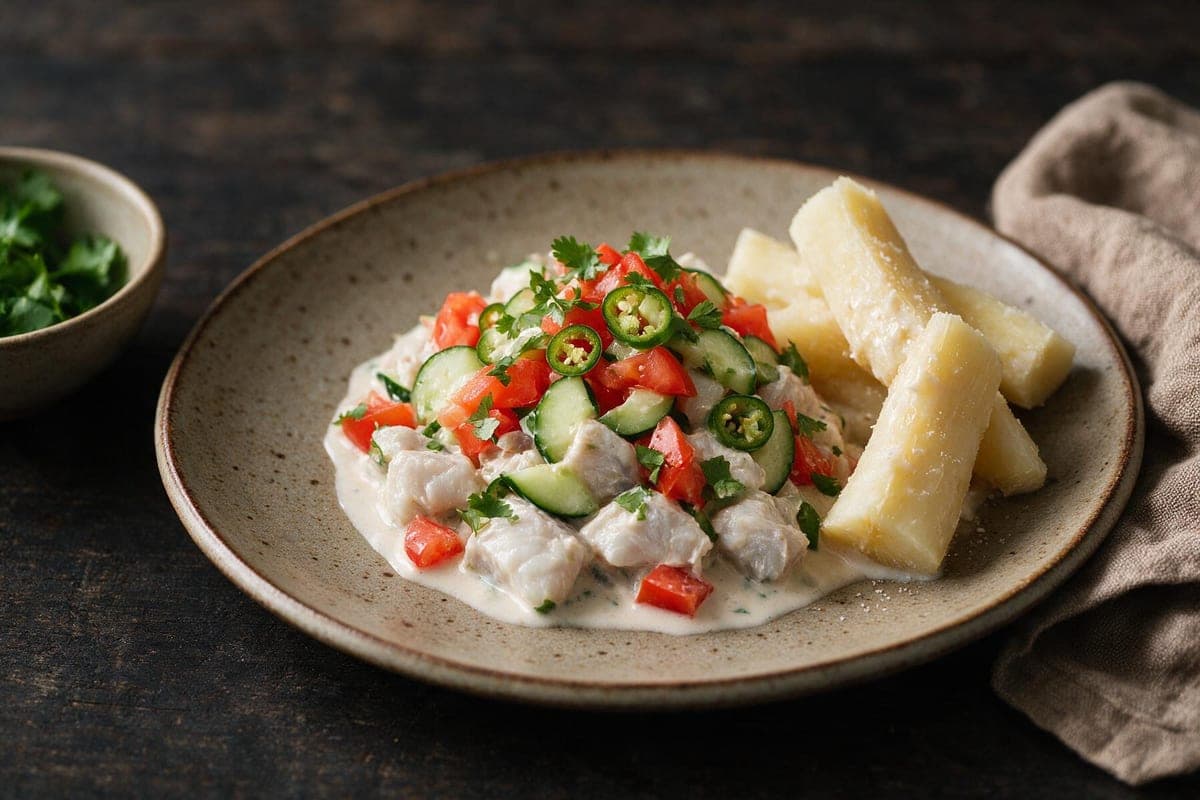
Fiji's creamy coconut-lime cured fish, bright with tomato, cucumber and chile, served with boiled cassava: a no-stove-for-the-main dinner that is mostly waiting for the lime to do its work.

- Prep
- 25 min
- Cook
- 25 min
- Total
- 50 min
- Serves
- 2 adults + 1 child
- Budget
- $22–$34
Kokoda (say it "ko-KON-da") is Fiji's raw fish salad: cubes of firm white fish "cooked" in lime juice until opaque, then folded into coconut milk with finely diced onion, tomato, cucumber and a little chile. It looks like ceviche but tastes creamy and gentle rather than sharp, because the coconut rounds off the citrus. We will serve it with boiled cassava, a starchy root that is a staple across Fiji, and a side of sliced cucumber and lime wedges. The fish cures in the fridge while the cassava boils, so the kitchen stays cool.
Why it's on our list
Fish is under-represented on our table, and this is a low-stress way in: no pan, no smoke alarm, and the hardest skill is knife work. I am also drawn to the idea of a dinner that is mostly waiting; cure the fish after school, boil the cassava, and dinner is assembled in five minutes. What I want to learn is how far lime alone takes raw fish, and whether my son will try a cube once he sees it turn white. The dish is lightly spiced as written, so I plan to serve the chile on the side rather than mixing it in.
Field notes · Origin & culture
Kokoda is widely described as Fiji's national dish and shows up at village Sunday lunches, resort buffets and family celebrations alike. Traditionally it was made with walu (Spanish mackerel) or another firm reef fish, cured in citrus and seasoned with chile and, according to Fiji-raised chef Robert Oliver, seawater; coconut milk became the standard dressing more recently. The dressing is a version of miti, the coconut-cream condiment with onion, citrus, tomato and chile that Fijians spoon over many dishes. Kokoda belongs to a wider Pacific family of coconut-cured fish salads, including Samoan oka and Tahitian poisson cru, and recipes vary from household to household, so treat this as one practical version rather than the definitive one.
Noteworthy ingredients
- Very fresh firm white fish: Mahi-mahi, snapper, halibut, or wild cod all work. Tell the fish counter you are curing it raw in lime and ask for the freshest fillet; previously frozen fish is fine and, for a home kitchen, is often the safer choice. Avoid anything with a strong smell.
- Full-fat canned coconut milk: Not the carton beverage. Shake well; the dish depends on its creaminess.
- Fresh cassava or frozen cassava chunks: Fresh cassava (also sold as yuca) is in the produce section of many large supermarkets and all Latin and Asian markets; frozen peeled chunks are easier and cook the same. Substitute: steamed rice or boiled potatoes.
- Limes, lots of them: The cure needs real fresh juice; bottled juice tastes flat. Buy a bag.
- Chile: A red Fresno or a bird's-eye chile is traditional. Keep it separate for a mild version.
Prep — 25 min
- Cut the fish into 3/4-inch cubes, trimming away any bloodline or soft bits. Put the cubes in a glass or ceramic bowl.
- Juice enough limes to make about 3/4 cup. Pour it over the fish with 1 teaspoon salt and stir so every piece is coated. Cover and refrigerate for 1–2 hours, stirring once; the fish should turn opaque all the way through when cut.
- Finely dice the onion and soak it in cold water for 10 minutes to tame its bite, then drain. Seed and dice the tomatoes; peel, seed and dice half the cucumber into small pieces and slice the rest into rounds for the side.
- Finely mince the chile, if using, and keep it in a tiny bowl. Chop the cilantro.
- If using fresh cassava, peel it with a knife (the skin is thick and waxy), cut into 3-inch lengths, halve them lengthwise and remove the tough fibrous core. Frozen chunks need no prep.
Cook — 25 min
- About 30 minutes before you want to eat, put the cassava in a pot, cover with cold water by 2 inches and add 1 teaspoon salt. Bring to a boil and cook 20–25 minutes, until a knife slides in with no resistance and the pieces are starting to split. Drain and keep warm.
- Drain most of the lime juice from the cured fish, leaving about 2 tablespoons behind. Discard the rest; it has done its job and would make the dish too sour.
- Pour the coconut milk over the fish. Add the onion, tomato, diced cucumber and most of the cilantro. Fold gently.
- Taste. Add salt, a squeeze of fresh lime if it needs brightness, and a little black pepper. Add the chile now only if everyone at the table wants heat; otherwise leave it on the side.
- Chill 10 minutes while you set the table so the flavors settle.
Serving
Spoon the kokoda into bowls or, Fijian-style, into halved coconut shells if you happen to have them, and scatter the remaining cilantro on top. Put the warm cassava on a platter with a pinch of salt; it is eaten in pieces, dipped into the coconut sauce. Set out cucumber rounds, lime wedges and the minced chile. For a mild plate, serve the fish and sauce without chile and with extra cucumber and cassava; the dish is naturally gentle. Kokoda does not keep well. Eat it the day you make it; leftover cassava can be refrigerated and fried in slices tomorrow.