Dinner night · Greece
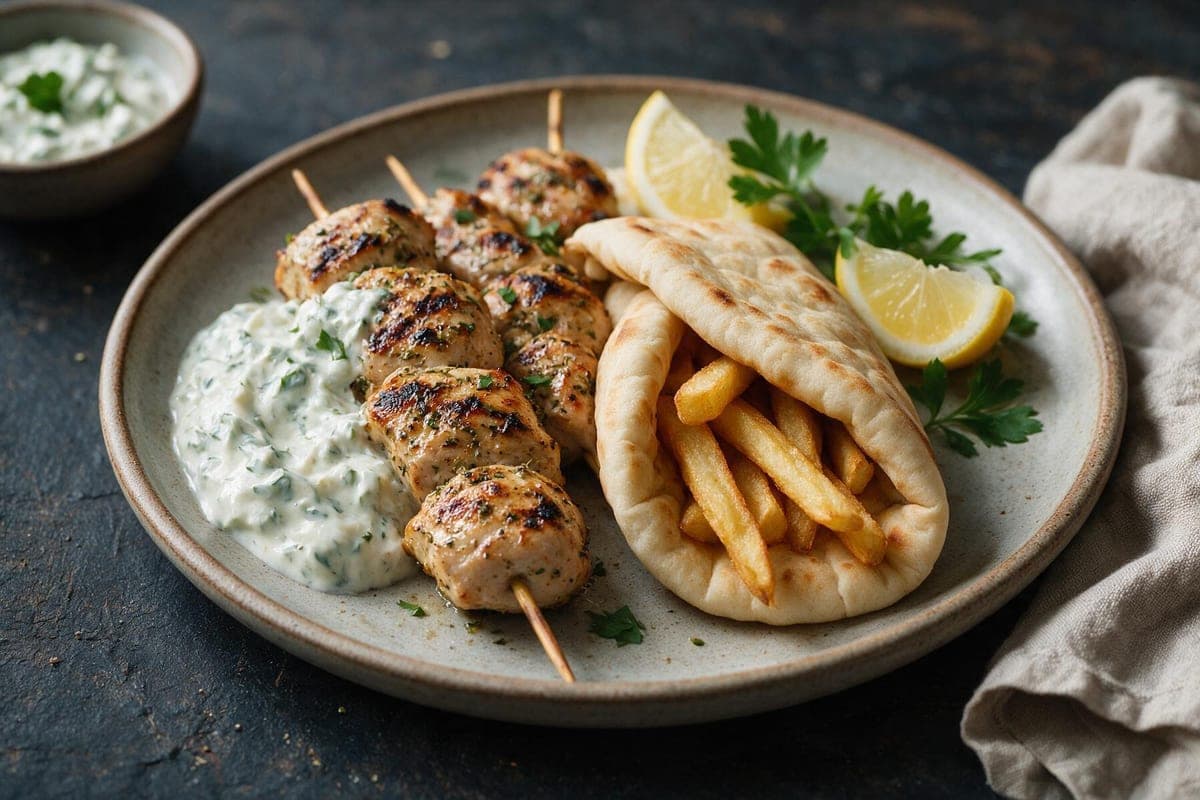
Chicken Souvlaki with Tzatziki
Lemon-oregano chicken skewers, cold garlicky tzatziki and warm pita: Greece's everyday street food, cooked on a skillet or grill pan in under 45 minutes.

- Prep
- 20 min
- Cook
- 20 min
- Total
- 40 min
- Serves
- 2 adults + 1 child, with 2 skewers left over
- Budget
- $18–$26
Souvlaki is small pieces of meat marinated in olive oil, lemon, garlic and oregano, threaded onto skewers and grilled until the edges char. We are making the chicken version, served the way a Greek souvlaki shop would: warm pita, cold tzatziki thick with grated cucumber and garlic, sliced tomato and red onion, and a few fries if you want to be authentic. Everyone builds their own at the table, which is half the fun.
Why it's on our list
Greece is one of the most requested cuisines in our house and somehow we have never given it a proper night. Souvlaki is the dish to start with because it is what Greeks actually eat on a Tuesday, not a holiday showpiece. I want to learn the marinade proportions well enough to stop measuring, and to find out whether a ridged grill pan gets close to the char of a street-corner grill. It is weeknight-feasible because the chicken cooks in minutes and everything else is assembly; the only wait is marinating, which can be as short as the time it takes to make tzatziki. Build-your-own pita wraps are also the kind of dinner where my son can choose exactly what goes on his, which usually means he eats more.
Field notes · Origin & culture
Cooking meat on skewers in Greece is ancient; stone supports for spits have been excavated on Santorini from before the 17th-century BC eruption, and the ancient Greek word obeliskos, "little spit," appears in Aristophanes and Aristotle. Modern souvlaki shops, by most accounts, spread across Greece after World War II, with Livadeia often cited for the first ones in the early 1950s. Pork is the most traditional meat on the skewer; chicken is now common everywhere. Terminology is a famous regional argument: in Athens a single skewer is a kalamaki ("little reed"), while in Thessaloniki and northern Greece souvlaki means the skewer itself and asking for a kalamaki gets you a drinking straw. Tzatziki, pita, tomato and onion are the standard accompaniments wherever you are.
Noteworthy ingredients
- Greek yogurt: Full-fat strained yogurt (Fage or Chobani plain whole milk) is the base of tzatziki; low-fat makes a watery sauce.
- Dried Greek oregano: It is more floral and peppery than Italian oregano. Mediterranean markets sell it on the branch; the standard spice-aisle jar is fine.
- Pocketless pita or Greek-style flatbread: Souvlaki is wrapped in a soft, thick pita, not stuffed into a pocket. Look for "Greek pita" or use naan or even flour tortillas in a pinch.
- Chicken thighs: Boneless, skinless thighs stay juicy on high heat where breast dries out. If you prefer breast, cut it larger and cook it a minute less.
- Fresh lemon and garlic: Both are used raw in the tzatziki and in the marinade; bottled juice tastes flat here.
Prep — 20 min
- If using wooden skewers, soak them in water now.
- Cut the chicken into 1 1/4-inch pieces. In a bowl, whisk 3 tablespoons olive oil, the juice of 1 lemon, 3 minced garlic cloves, the oregano, paprika, 1 teaspoon salt and plenty of black pepper. Add the chicken, toss well, and marinate at room temperature while you make everything else (30 minutes is ideal; up to 4 hours in the fridge).
- Tzatziki: grate half the cucumber on the large holes of a box grater, toss with 1/2 teaspoon salt, and squeeze hard in your hands or a clean towel to remove the water. Stir it into the yogurt with 2 finely grated garlic cloves, 1 tablespoon olive oil, the vinegar, 1 tablespoon lemon juice, and 2 tablespoons chopped dill or mint. Season and refrigerate.
- Slice the tomatoes and the red onion thin; slice the remaining cucumber. Chop a little parsley. Cut the last lemon into wedges.
- If making fries, cut the potatoes into sticks, toss with oil and salt, and roast at 425°F for 30–35 minutes, turning once.
- Thread the chicken onto skewers without packing the pieces tightly, so heat reaches all sides.
Cook — 20 min
- Heat a grill pan or cast-iron skillet over medium-high until a drop of water sizzles off instantly. Brush lightly with oil. (A gas or charcoal grill is traditional and even better.)
- Lay the skewers in the pan without crowding, in two batches if needed. Cook 3–4 minutes per side, turning three or four times total, until charred at the edges and the thickest piece reads 165°F; about 10–12 minutes.
- Rest the skewers on a plate for a few minutes, squeeze a little lemon over them, and tent loosely with foil.
- Wipe the pan, lower the heat to medium, and warm each pita 30–45 seconds per side until soft and pliable with a few toasted spots. Stack them in a towel to keep warm.
Serving
Set out the warm pitas, skewers, tzatziki, tomato, onion, cucumber, parsley and lemon wedges and let everyone build their own: a smear of tzatziki down the middle, chicken slid off the skewer, a few vegetables, a sprinkle of salt and oregano, then roll. Fries tucked inside the wrap are genuinely how many souvlaki shops do it. My son can skip the raw onion and keep his pita simple; the chicken itself has no heat. Leftover chicken keeps for three days and makes a very good lunch salad over greens with the extra tzatziki, which also keeps for three days.