Dinner night · Haiti
Poul nan Sòs with Diri Kole
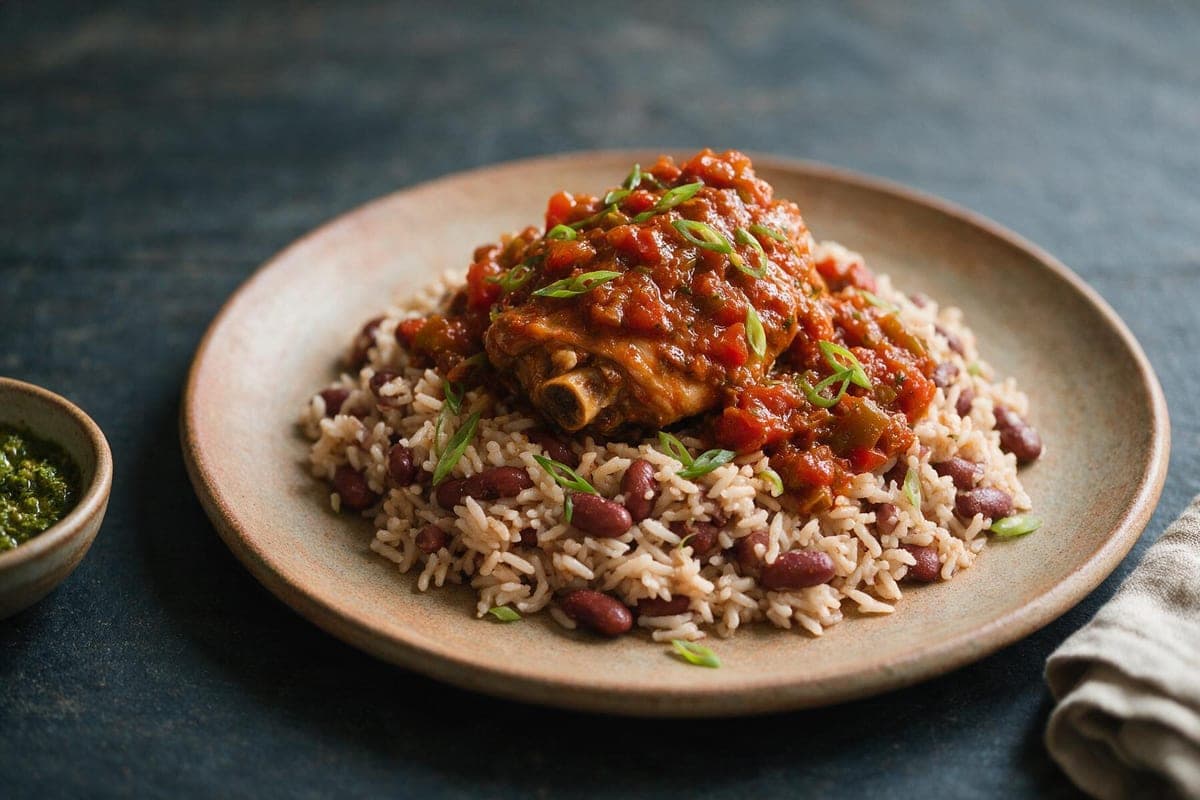
Haitian stewed chicken in a tomato-pepper sauce built on epis, the island's green herb paste, over diri kole ak pwa, rice cooked with red beans and coconut: a Sunday plate made weeknight-sized.

- Prep
- 25 min
- Cook
- 45 min
- Total
- 70 min
- Serves
- 2 adults + 1 child, with leftovers
- Budget
- $17–$25
Poul nan sòs ("chicken in sauce") is chicken thighs rubbed with lime and epis, Haiti's blended paste of parsley, scallion, garlic, thyme and bell pepper, then browned and simmered in a sauce of tomato paste, onion, more bell pepper and a whole Scotch bonnet floated in the pot for perfume rather than fire. It is eaten over diri kole ak pwa, rice cooked in red-bean liquid with a little coconut milk, garlic and thyme, so it comes out savory and faintly rosy. Together they are the backbone plate of Haitian home cooking.
Why it's on our list
Haiti's food is one of the great Caribbean cuisines and it is almost invisible on US supermarket shelves, so I want to learn it from the ground up, starting with epis, the seasoning paste in nearly every Haitian savory dish; a jar in the fridge opens up a dozen other dinners. The other skill is cooking rice in bean liquid for color and depth. It is weeknight-feasible because canned beans and a blender collapse the longest steps. I will keep the Scotch bonnet whole so the sauce stays gentle, and put pikliz, the fiery pickled slaw, on the table for the adults.
Field notes · Origin & culture
Haitian cooking grew out of the meeting of West African, French and Indigenous Taíno foodways on the western third of Hispaniola, shaped by the plantation economy and then by independence in 1804. Epis, the herb-and-pepper paste at the heart of this dish, has parallels in the sofritos of the Spanish Caribbean, but its heavy use of parsley, thyme and scallion is distinctly Haitian. Diri kole ak pwa, rice "stuck together" with beans, is widely described as Haiti's national rice dish; red kidney beans are usual, though black beans and pigeon peas are also used. Poul nan sòs is everyday and Sunday food alike, and recipes vary by household in how much tomato and pepper go in and whether the chicken is fried first. This version follows a common home method and is not the only right one.
Noteworthy ingredients
- Epis: Made fresh here from parsley, scallions, garlic, thyme, green bell pepper, oil and lime. Five minutes in a blender; keeps two weeks refrigerated. Some Caribbean markets sell it jarred.
- Scotch bonnet pepper: Dropped into the sauce whole and lifted out before serving, it adds fruity aroma without much heat. Habanero substitutes. Skip it for a fully mild pot.
- Red kidney beans and coconut milk: Canned beans make the rice possible on a weeknight; use their liquid plus water. A little coconut milk rounds the flavor.
- Bouillon cube: Many Haitian cooks season with a chicken bouillon (Maggi) cube; reduce added salt accordingly.
Prep — 25 min
- Make the epis: blend 1 cup parsley, 4 scallions, 5 garlic cloves, the leaves from 4 thyme sprigs, half a green bell pepper, 2 tablespoons oil, the juice of 1 lime and 1/2 teaspoon salt into a coarse paste (about 3/4 cup).
- Pat the chicken dry. Rub it with the juice of the second lime and 1/3 cup of the epis, and let it sit while you do the rest (overnight is traditional; 20 minutes is fine). Refrigerate the remaining epis.
- Slice the onion and the remaining bell pepper into strips. Smash the remaining 3 garlic cloves. Slice the remaining scallions for garnish.
- Drain the beans, saving the liquid in a measuring cup; add water to reach 2 3/4 cups.
Cook — 45 min
- Heat 1 tablespoon oil in a Dutch oven over medium-high heat. Scrape most of the marinade off the chicken (save it) and brown the pieces 3–4 minutes per side. Move to a plate.
- Lower the heat to medium, add the onion and bell pepper with a pinch of salt, and cook 5 minutes. Add the tomato paste and cook 2 minutes until it darkens. Add the reserved marinade and 1 1/2 cups water, stir smooth, and crumble in half the bouillon cube.
- Return the chicken and nestle the whole Scotch bonnet into the sauce, stem up, if using. Cover and simmer gently 30 minutes, turning once, until the chicken is tender and the sauce has thickened. Lift out the pepper before it bursts. Taste for salt and add a squeeze of lime.
- Meanwhile, make the diri kole: heat the remaining oil in the rice pot over medium heat. Sizzle the smashed garlic and 2 thyme sprigs 1 minute. Add the beans and cook 2 minutes, then the bean liquid, coconut milk, the other half of the bouillon cube and 1/2 teaspoon salt. Bring to a boil.
- Stir in the rice, return to a boil, then cover, reduce to the lowest heat and cook 18 minutes. Rest off the heat, covered, 5 minutes. Remove the thyme stems and fluff.
Serving
Mound diri kole on each plate, lay a piece of chicken on top and spoon plenty of sauce over the rice; the sauce is the point. Scatter sliced scallions over the plate. The pot is only gently warm from the whole pepper, so my son's plate is the same as ours, and the heat lives in a dish of pikliz (shredded cabbage, carrot, Scotch bonnet and vinegar) for the adults. Fried plantain or sliced avocado on the side is traditional. Leftovers keep three days; the rice reheats well with a splash of water.