Dinner night · Kazakhstan
Weeknight Beshbarmak
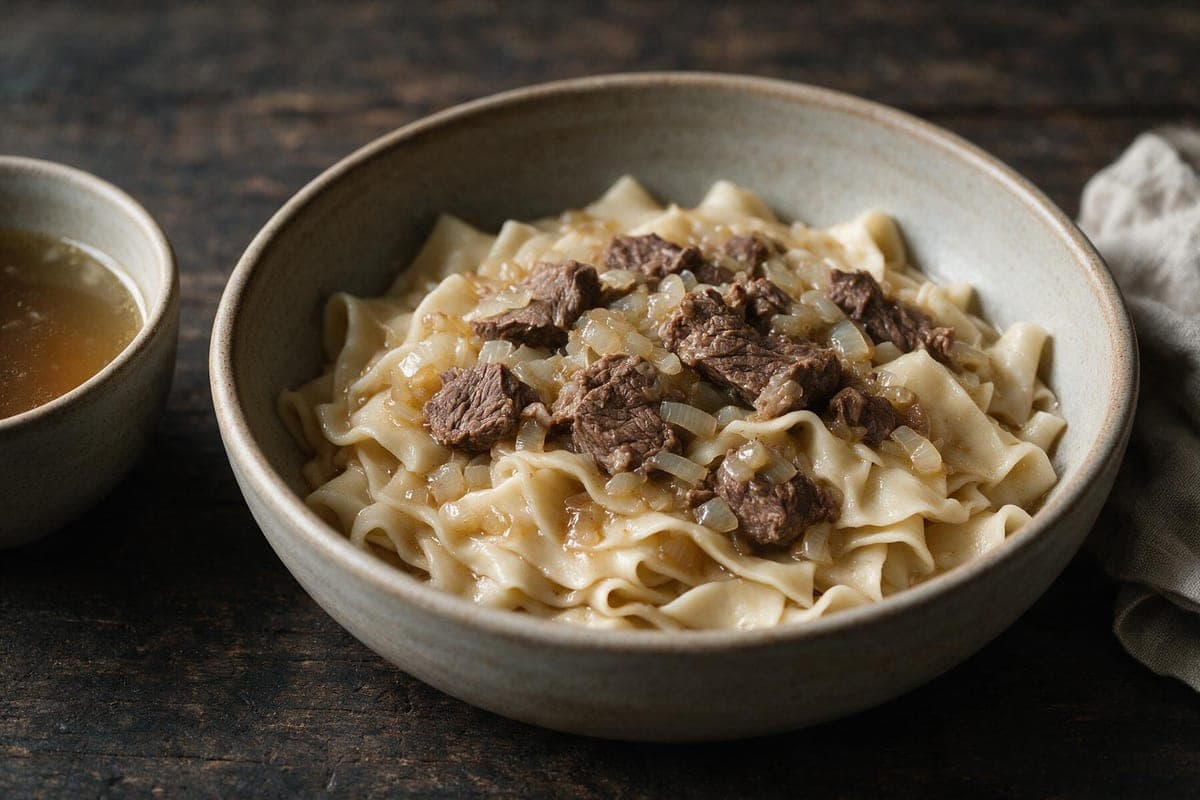
Kazakhstan's "five fingers" dish of tender boiled beef over wide noodles with an onion-rich broth sauce, shortened from an all-day feast to a long weeknight.

- Prep
- 15 min
- Cook
- 75 min
- Total
- 90 min
- Serves
- 2 adults + 1 child, with broth left for lunch
- Budget
- $16–$24
Beshbarmak is Kazakhstan's national dish and the center of its feast table: meat boiled slowly until it falls apart, thin sheets of noodle cooked in the meat broth, and a sauce of onions softened in the same broth spooned over everything. The flavor is deeply plain in the best way, like the clearest beef soup you have ever had, poured over pasta. A cup of the hot broth, called sorpa, comes alongside. Our version uses beef chuck and store-bought wide noodles so it fits into an evening instead of an afternoon.
Why it's on our list
Central Asia is nearly empty on our map, and beshbarmak is the dish Kazakhs themselves name first. I am drawn to how little it asks: meat, water, salt, onion, flour, black pepper, and time. There is no spice blend to get wrong and nothing for a cautious eater to object to. The lesson I expect to learn is restraint: letting a broth taste of meat and onion and nothing else, then using that one broth three ways, to cook the noodles, to make the onion sauce, and to drink. The weeknight compromise is honest: a long simmer of beef chuck replaces the traditional hours of boiling horse meat or mutton, and fresh pasta sheets stand in for hand-rolled dough.
Field notes · Origin & culture
Beshbarmak (also besbarmak or et, "meat") comes from the Turkic words for "five fingers," because it was traditionally eaten by hand from a shared platter. It belongs to the nomadic herding cultures of the Kazakh steppe and is also eaten in Kyrgyzstan and other parts of Central Asia, with regional variations. Horse meat and mutton were the traditional choices, often with kazy, a horse-meat sausage, and the boiled meat was carved and served according to the guest's status and age. The noodles, cooked in the broth, are laid under the meat, and a sauce of onion simmered in fatty broth, tuzdyk, goes over the top. The broth itself, sorpa, is served in bowls alongside, sometimes with crumbled qurt, a dried salted cheese. It remains the dish for weddings, holidays such as Nauryz, and honored guests.
Noteworthy ingredients
- Beef chuck roast: The weeknight substitute for mutton or horse meat. Cut into 2-inch pieces it needs about 70 minutes to turn tender, roughly a third of the traditional time. Bone-in short ribs make an even richer broth if the price is right.
- Wide noodles: Traditional zhaima are hand-rolled sheets cut into palm-sized diamonds. Fresh lasagna sheets from the refrigerated pasta case, cut into squares, come closest; dried pappardelle or wide egg noodles also work.
- Onions: Not a garnish but the sauce. Two large yellow onions, sliced thin and softened in a ladle of the fatty broth with black pepper, is the whole of tuzdyk.
- Bay leaf and black peppercorns: The only seasonings beyond salt. Resist adding garlic, herbs, or stock cubes; the point is a clean meat broth.
Prep — 15 min
- Cut the chuck into 2-inch chunks (leave short ribs whole). Peel and halve the medium onion.
- Put the beef in a Dutch oven with 8 cups cold water, the halved onion, bay leaves, peppercorns, and 1 1/2 teaspoons salt. The beef should be covered by at least an inch of water.
- Slice the two large onions into thin half-moons. Peel the potatoes, if using, and cut into 2-inch pieces. Chop the parsley or dill.
- If using fresh lasagna sheets, cut them into roughly 3-inch squares and keep them covered with a towel so they do not dry out.
Cook — 75 min
- Bring the pot to a boil over high heat, then lower to a gentle simmer. Skim off the gray foam that rises in the first 5 minutes. Cover partially and simmer 60–70 minutes, until a fork slides into the beef with no resistance, topping up with hot water if the level drops below the meat.
- If using potatoes, add them for the last 25 minutes of the simmer.
- Lift the beef (and potatoes) onto a platter and tent with foil. Fish out the bay leaves and onion halves. Taste the broth and salt it until it tastes like a soup you would happily drink.
- Ladle 1 1/2 cups of the broth, taking it from the top where the fat has collected, into a small saucepan. Add the sliced onions, 1/2 teaspoon ground black pepper, and a pinch of salt. Simmer 8–10 minutes until the onions are soft and translucent but still hold their shape. This is the tuzdyk.
- Bring the main pot of broth back to a boil and cook the noodle squares in it, 3–4 minutes for fresh sheets or according to the package for dried. Lift them out with a slotted spoon or tongs and spread them over the platter.
- Shred or slice the beef into generous pieces and arrange it over the noodles with the potatoes. Spoon the onions and their broth over everything and scatter the herbs on top. Ladle the remaining broth into small cups.
Serving
Bring the whole platter to the table rather than plating individually; sharing from one dish is the heart of beshbarmak. Each person takes noodles, meat and onions onto a plate and sips the hot sorpa from a cup between bites. There is no heat here at all, so my son's plate will be identical to ours; if he is suspicious of the onions I will give him plain noodles and beef with a spoon of broth, which is still the dish. Leftover beef and broth keep three days and make an excellent soup the next day; cook fresh noodles rather than storing them in the broth, where they turn soft.