Dinner night · Lesotho
Papa le Moroho with Chicken
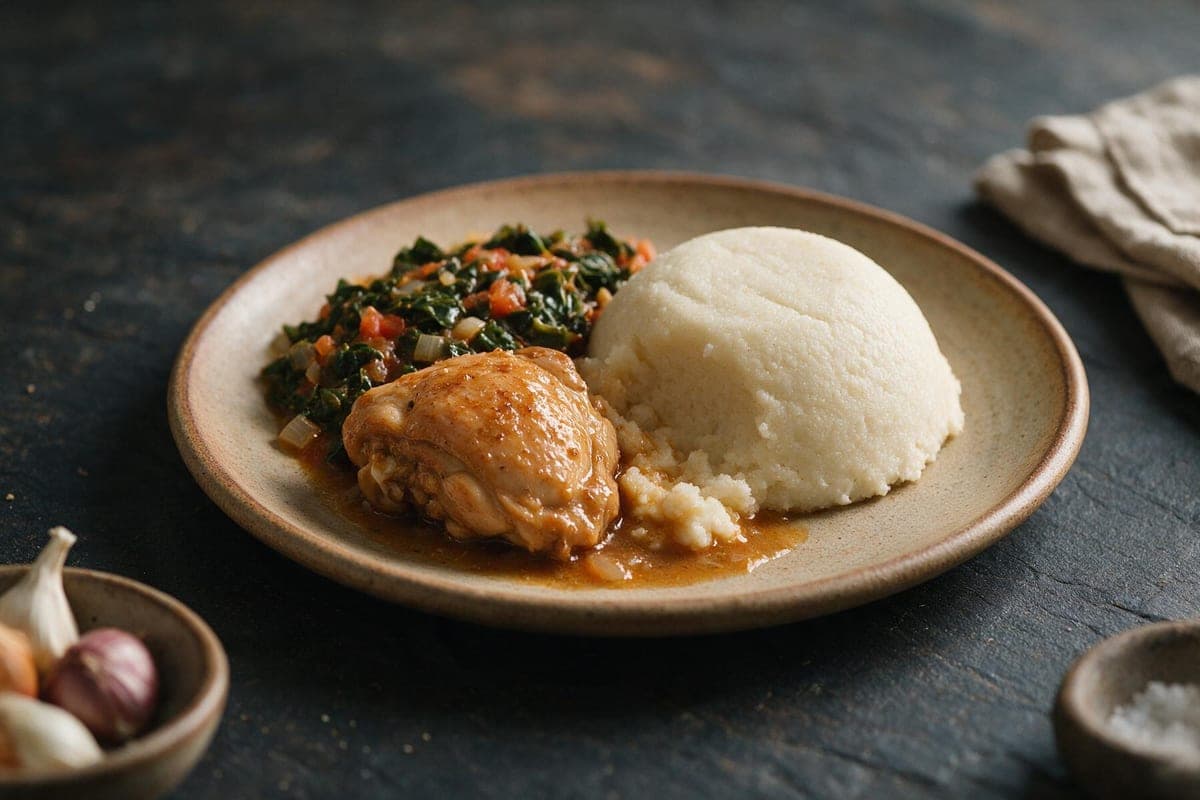
The everyday plate of Lesotho: firm maize porridge, greens cooked with onion and tomato, and simple pan-stewed chicken, all done in 50 minutes.
- Prep
- 15 min
- Cook
- 35 min
- Total
- 50 min
- Serves
- 2 adults + 1 child
- Budget
- $13–$20
Papa le moroho means porridge and greens in Sesotho, and it is the plate most people in Lesotho eat most days: papa, a stiff white maize-meal porridge cooked until it can be pinched off with the fingers; moroho, leafy greens such as spinach, kale, cabbage or pumpkin leaves simmered with onion, tomato and oil until soft and savory; and nama, meat, when there is some, here chicken thighs stewed with onion and tomato until the gravy is thick. Nothing about it is complicated. It is seasoned mostly with salt, and the pleasure is in soft, hot porridge, bright greens and rich chicken gravy together.
Why it's on our list
Lesotho is a small mountain kingdom that few of us could place on a map, and I want our visit to be the honest everyday meal rather than something invented for tourists. The skill I want to learn is papa, the stiff maize porridge that belongs to a family of southern African staples (pap, sadza, nshima, ugali) and is stirred with a stick called a lesokoana; getting it smooth and firm is a technique, and I expect to get it wrong once. It is weeknight-feasible because all three parts cook in parallel in about 35 minutes, and it is completely mild, so there is no plate to adjust for my son. It is also one of the cheapest dinners we will ever make.
Field notes · Origin & culture
Lesotho is a highland country entirely surrounded by South Africa, and Basotho cooking is shaped by its altitude and its farming: maize, sorghum, beans, pumpkins and greens, with sheep, goats and chickens, and British influences from the colonial period in the baking. Papa is made by stirring maize meal into boiling water with a lesokoana, a long wooden stick, until it is thick enough to stand; moroho covers whatever greens are in season, often wild greens in the countryside and spinach or cabbage in town, and lepu, greens with young squash, is a well-known variation. Sorghum appears as motoho, a sour fermented porridge, and in likhobe, a stew of sorghum, beans and berries. Meals are eaten with the right hand, using a piece of papa to scoop up greens and gravy. This is a mainstream home version, not one definitive recipe.
Noteworthy ingredients
- White maize meal: The traditional grain for papa. Look for "maize meal" or "mealie meal" (brands like Iwisa or White Star) at African groceries and online; fine white cornmeal from a regular supermarket works with a slightly different texture. Avoid coarse polenta.
- Greens: Spinach is the easiest moroho. Kale or collards are closer to the sturdier greens often used in Lesotho and take 10 minutes longer; cabbage is also common.
- Bone-in chicken thighs: Chicken in Lesotho is a treat, often a mature bird that needs long stewing; thighs give the same flavor in 30 minutes.
- Tomato and onion: The base of both the greens and the chicken gravy. A bouillon cube is a common seasoning across the region and is optional here.
Prep — 15 min
- Pat the chicken dry and season with 1 teaspoon salt, black pepper and the paprika.
- Dice both onions and all three tomatoes; mince the garlic. Keep half the onion and one tomato for the greens.
- Wash the greens, strip any tough stems and chop into ribbons.
- Measure the maize meal and put 4 cups water with 1 teaspoon salt in a heavy saucepan, ready to boil.
Cook — 35 min
- Chicken: Heat 2 tablespoons oil in a large skillet over medium-high. Brown the thighs skin-side down 5 minutes, turn and brown 3 minutes more. Move to a plate. Lower heat to medium, add half the onion and cook 4 minutes, then the garlic for 1 minute, then the tomato paste and two of the tomatoes; cook 3 minutes until saucy. Return the chicken with 3/4 cup water and the crumbled bouillon if using, cover and simmer 25 minutes, turning once, until the chicken reaches 165°F and the gravy is thick. Uncover for the last 5 minutes if it is thin.
- Papa: Bring the salted water to a boil. Whisk 1 cup of the maize meal into the water in a slow stream, stirring constantly to avoid lumps, and cook 5 minutes, stirring, until it thickens to a smooth porridge. Add the second cup of maize meal and stir hard with a wooden spoon until it comes together into a stiff mass that pulls away from the pan, 3–4 minutes. Lower the heat to the minimum, cover and let it steam 10–15 minutes, stirring once or twice, until dry and firm. It should hold a shape when scooped.
- Moroho: Heat the remaining 1 tablespoon oil in a second pan over medium. Cook the reserved onion 4 minutes, add the reserved tomato and cook 3 minutes, then add the greens with a pinch of salt and 1/4 cup water. Cover and cook 6–8 minutes for spinach or 15 for kale, stirring now and then, until very tender. Season with salt and a squeeze of lemon.
Serving
Scoop a generous mound of papa onto each plate (a wet spoon shapes it neatly), put the greens beside it and a chicken thigh with gravy alongside, so the gravy runs into the porridge. The traditional way to eat it is with the right hand, pinching off a piece of papa, pressing a dent into it and scooping up greens and gravy; forks are fine, and I expect my son will want to try the hand method. There is no heat to manage. Leftover papa firms up in the fridge and can be sliced and pan-fried the next morning; the chicken and greens keep two days.