Dinner night · Nicaragua
Gallo Pinto with Eggs, Queso and Plantains
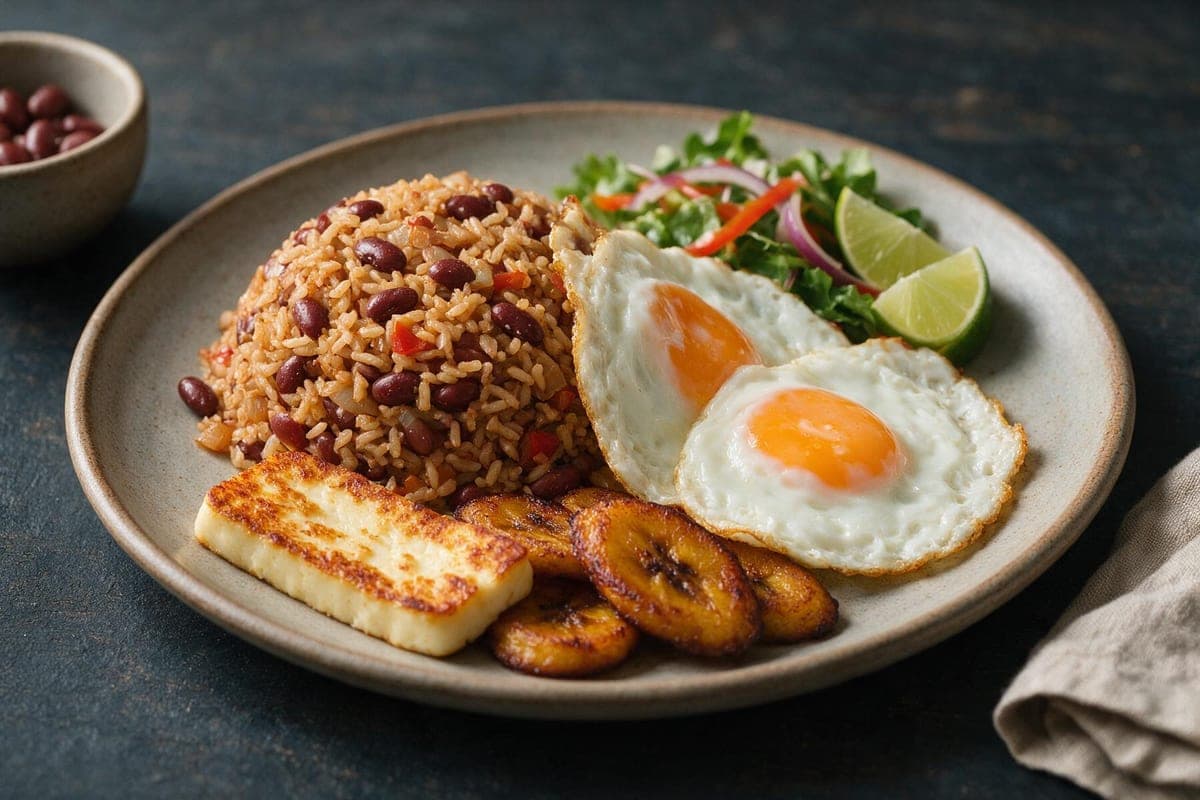
Nicaragua's everyday rice-and-red-beans, crisped in a skillet with onion and sweet pepper, plus fried eggs, pan-seared cheese and caramelized plantains: a vegetarian plate that costs almost nothing and comes together in 35 minutes.
- Prep
- 15 min
- Cook
- 20 min
- Total
- 35 min
- Serves
- 2 adults + 1 child, with gallo pinto left for tomorrow's breakfast
- Budget
- $10–$16
Gallo pinto is rice and red beans fried together until the rice picks up the color of the bean liquid and the edges get a little crisp. In Nicaragua it is eaten morning, noon and night, and a plate of it with fried eggs, a slab of pan-seared salty cheese and sweet fried plantains is about as ordinary and as good as Nicaraguan home cooking gets. There is no meat, no long simmer and nothing you cannot buy at a regular supermarket.
Why it's on our list
Our map leans hard on chicken, and I want more dinners built on beans, eggs and vegetables that still feel like a complete plate. Gallo pinto is exactly that: cheap, filling, and a dish an entire country eats daily. I also want to learn the two small techniques that make it work, letting the rice sit untouched long enough to crisp, and frying plantains ripe enough to caramelize instead of turning starchy. It is weeknight-feasible because day-old rice is actually better here, and the eggs, cheese and plantains all cook while the gallo pinto crisps. There is no heat anywhere in the dish, so my son's plate is the same as ours.
Field notes · Origin & culture
Gallo pinto, "spotted rooster," is named for the speckled look of rice fried with beans. Both Nicaragua and Costa Rica call it a national dish and argue over who had it first; most accounts agree the roots are Afro-Caribbean, with rice-and-bean cooking carried along the Caribbean coast and through the banana plantations where laborers from both countries worked side by side. The Nicaraguan version is usually made with small red beans (often called red silk beans) and onion, fried in oil; Costa Rica leans toward black beans and a splash of Salsa Lizano. In Nicaragua it appears at breakfast with eggs and tortillas, at lunch beside meat, and at dinner with fried cheese and maduros. I will not take sides on the origin dispute, but I will cook it the Nicaraguan way.
Noteworthy ingredients
- Small red beans: Canned small red beans (labeled "small red beans" or "habichuelas rojas") are the right ones. Do not drain them completely; a few spoonfuls of the liquid stain the rice its proper color. Pinto or kidney beans are a fine fallback.
- Queso para freír: A firm, salty frying cheese sold in the Hispanic dairy section. It browns in a dry pan without melting into a puddle. Halloumi behaves the same way.
- Very ripe plantains: You want skins that are mostly black. A yellow plantain with green ends will be starchy and bland; buy a day or two ahead and let them ripen on the counter.
- Day-old rice: Cold cooked rice fries into separate grains and crisps; fresh hot rice turns gummy. If you cook the rice the same day, spread it on a tray to cool for 20 minutes first.
Prep — 15 min
- If you do not have leftover rice, cook 1 1/2 cups rice with 2 1/4 cups water and a pinch of salt. Spread it on a sheet pan to cool while you prep everything else.
- Dice the onion and bell pepper small. Mince the garlic. Chop a handful of cilantro leaves.
- Open the beans. Drain off about half the liquid and keep the rest with the beans.
- Peel the plantains (score the skin lengthwise and peel it away) and slice on a diagonal into 1/2-inch pieces.
- Cut the cheese into 1/2-inch slabs and pat dry; dry cheese browns, wet cheese steams.
- If making the salad, dice the tomatoes and avocado and toss with lime juice, salt and a little cilantro.
Cook — 20 min
- Heat 2 tablespoons oil in the large skillet over medium heat. Add the onion and bell pepper with a pinch of salt and cook 5–6 minutes until soft and lightly golden. Add the garlic and cumin and stir for 30 seconds.
- Add the beans with their reserved liquid. Let them bubble 2–3 minutes until the liquid has reduced by about half and looks glossy.
- Add the rice and stir to coat every grain in the bean liquid. Season with salt and pepper. Spread it out and leave it alone 3–4 minutes so the bottom crisps; stir, spread again, and repeat twice more. Stir in most of the cilantro and turn the heat to low.
- Meanwhile, heat 1 tablespoon oil in the second skillet over medium heat. Fry the plantain slices 2–3 minutes per side until deep golden with dark caramelized edges. Move to a paper-towel-lined plate and sprinkle with a tiny pinch of salt.
- In the same skillet, with no added oil, cook the cheese slabs 1–2 minutes per side until golden-brown and blistered. Move to the plantain plate.
- Add the last tablespoon of oil and fry the eggs; I would go for crisp, lacy edges and runny yolks. Season with salt and pepper.
Serving
Spoon a mound of gallo pinto onto each plate, lean two eggs against it, and add a slab of cheese and a few plantain slices alongside, with the salad and lime wedges if you made them. Warm corn tortillas are traditional and let my son build his own little tacos. Nothing is spicy, though hot sauce on the table is fair for the adults. Leftover gallo pinto keeps three days and reheats in a hot skillet with a teaspoon of oil into tomorrow's breakfast, which is how Nicaraguans eat most of it anyway.