Dinner night · Niger
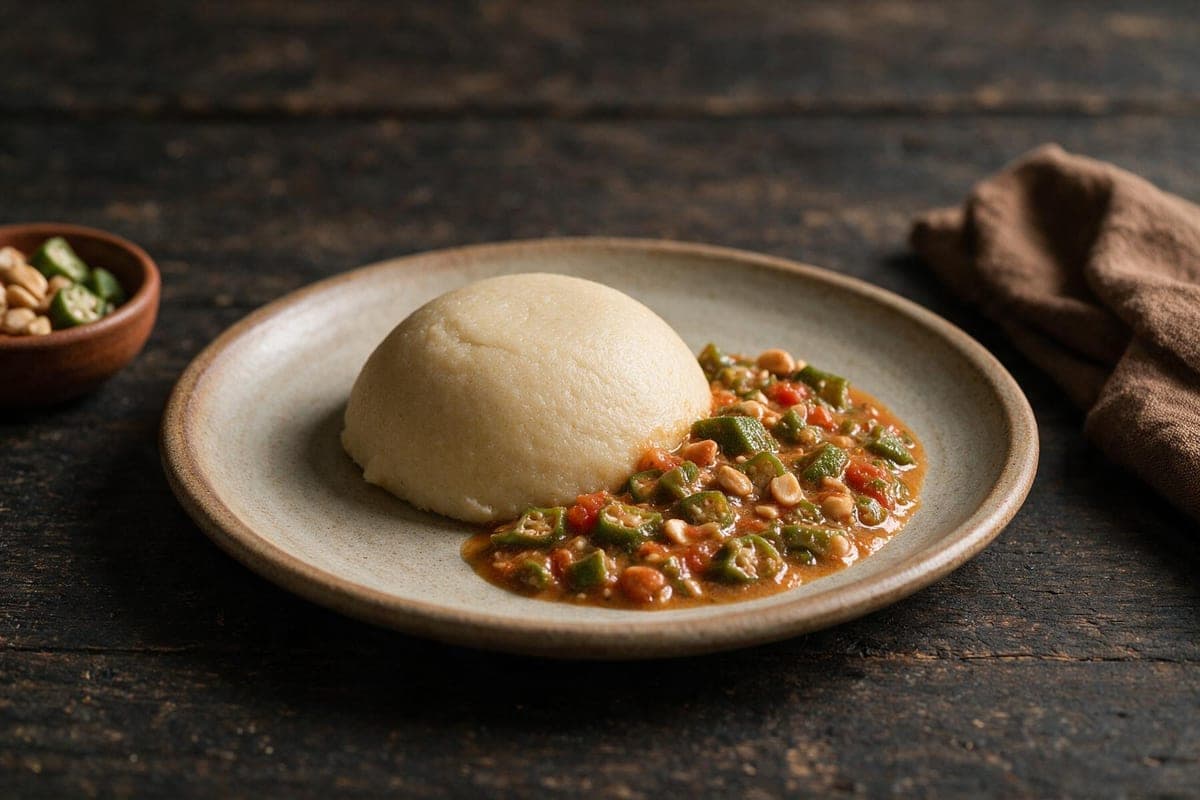
Tuwo with Okra-Peanut Sauce
Niger's soft rice mash with a silky okra, tomato and peanut sauce: a vegetarian Sahel dinner that costs almost nothing and comes together in an hour.

- Prep
- 15 min
- Cook
- 45 min
- Total
- 60 min
- Serves
- 2 adults + 1 child, with sauce left over
- Budget
- $10–$16
Tuwo is the thick, smooth starch at the center of a Nigerien meal: here, tuwon shinkafa, rice cooked soft with extra water and mashed into a dense, sticky mound that you eat with your hand. Beside it goes a sauce of okra, tomato, onion and ground peanuts, simmered until the okra turns silky and the peanut thickens everything into a glossy, savory gravy. The okra gives the sauce its characteristic slip, which is prized in the Sahel, and the peanut gives body and richness. Our version is vegetarian; a traditional pot would often include dried or smoked fish, or a little beef.
Why it's on our list
Niger is one of the least-represented countries in any food conversation, and its cooking is built on the grains and legumes of the Sahel rather than on meat, which is exactly what I want more of on our map. I want to learn two things: how to make tuwo, the starch-mash that anchors meals across Niger and northern Nigeria, and how okra behaves when it is cooked to be slippery on purpose. Okra is the vegetable my son is most suspicious of, so this is a genuine experiment. It is weeknight-feasible because both parts are one pot each and the ingredients cost under fifteen dollars; the only unusual item is natural peanut butter, which we already keep.
Field notes · Origin & culture
Nigerien meals usually pair a starch with a sauce or stew. The starch is often tuwo (Hausa; in French sources touwo), a stiff porridge made from rice, millet, sorghum or maize; tuwon shinkafa, the rice version, is described as originating in Niger and northern Nigeria among Hausa communities, who make up the largest share of Niger's population. The sauces are mostly vegetable-based and seasoned generously: okra, baobab leaf, peanut and tomato sauces are all common, and dambou, couscous mixed with moringa leaves, is a national favorite. Peanuts have long been one of Niger's main cash crops, and ground peanut paste is a standard thickener. Spices such as ginger, cloves and cinnamon reached the region with trans-Saharan trade. Okra-and-peanut sauces of this kind are shared with Nigeria, Mali and Chad; the proportions and names shift from one kitchen to the next, so this is a home version rather than a single canonical recipe.
Noteworthy ingredients
- Okra: Fresh is best; choose small, firm pods and slice them thin so they release their thickening quality. Frozen sliced okra works well and is often cheaper; add it straight from the bag.
- Natural peanut butter: Unsweetened, peanuts-only (Smucker's Natural, Whole Foods 365). It stands in for the freshly ground peanut paste of a Nigerien market.
- Short- or medium-grain rice: For tuwo you want rice that cooks soft and sticky. Jasmine or Calrose both work; basmati stays too separate.
- Dried crayfish or smoked fish (optional): Traditional for depth and not vegetarian; a tablespoon of ground dried shrimp gives the same savory note if you want it.
- Bouillon: Nigerien cooks use a seasoning cube freely. A teaspoon of vegetable bouillon is the honest equivalent; check the label if gluten matters.
Prep — 15 min
- Rinse the rice well. Trim the okra and slice into 1/4-inch rounds.
- Dice the onion, mince the garlic and grate the ginger. Core and chop the tomatoes. If using greens, strip the stems and chop the leaves.
- Stir the peanut butter with 1 cup hot water until smooth.
Cook — 45 min
- Start the tuwo: put the rinsed rice in a heavy saucepan with 5 cups water and 1/2 teaspoon salt. Bring to a boil, lower to a simmer, cover and cook 20 minutes, stirring once or twice, until the rice is very soft and most of the water is absorbed. Turn the heat to its lowest setting.
- Mash the rice in the pot with a potato masher or beat it hard with a wooden spoon for 2–3 minutes until it becomes a smooth, thick, stretchy mass with no distinct grains. Add a splash of hot water if it is too stiff to stir. Cover and keep warm.
- For the sauce, heat the oil in a large skillet over medium. Cook the onion with a pinch of salt 5 minutes until soft. Add the garlic, ginger and tomato paste; stir 1 minute. Add the tomatoes and cook 4 minutes until they break down.
- Add the okra, 1 1/2 cups water, the bouillon and the whole chile if using. Simmer 10 minutes, until the okra softens and the sauce turns slightly slippery when you lift the spoon.
- Stir in the thinned peanut butter and the greens if using. Simmer 10 minutes more, stirring often so the peanut does not catch, until the sauce is thick, glossy and coats the okra. Add water if it tightens too much. Remove the chile; season with salt and black pepper.
- Wet a small bowl or ladle, pack it with tuwo, and turn it out onto each plate as a smooth dome. Repeat.
Serving
Put a dome of tuwo on each plate with a ladle of okra-peanut sauce beside or over it. Eat as Nigeriens do, pinching off a piece of tuwo with the right hand and using it to scoop the sauce, or with a spoon; both are fine at our table. The sauce as written is mild, so my son's plate is the same as ours, and I'll put cayenne and hot sauce out for adults. Leftover sauce keeps three days and thickens in the fridge; loosen with water. Leftover tuwo can be sliced cold and fried in a little oil until the outside crisps.