Dinner night · Panama
Sancocho de Gallina Panameño
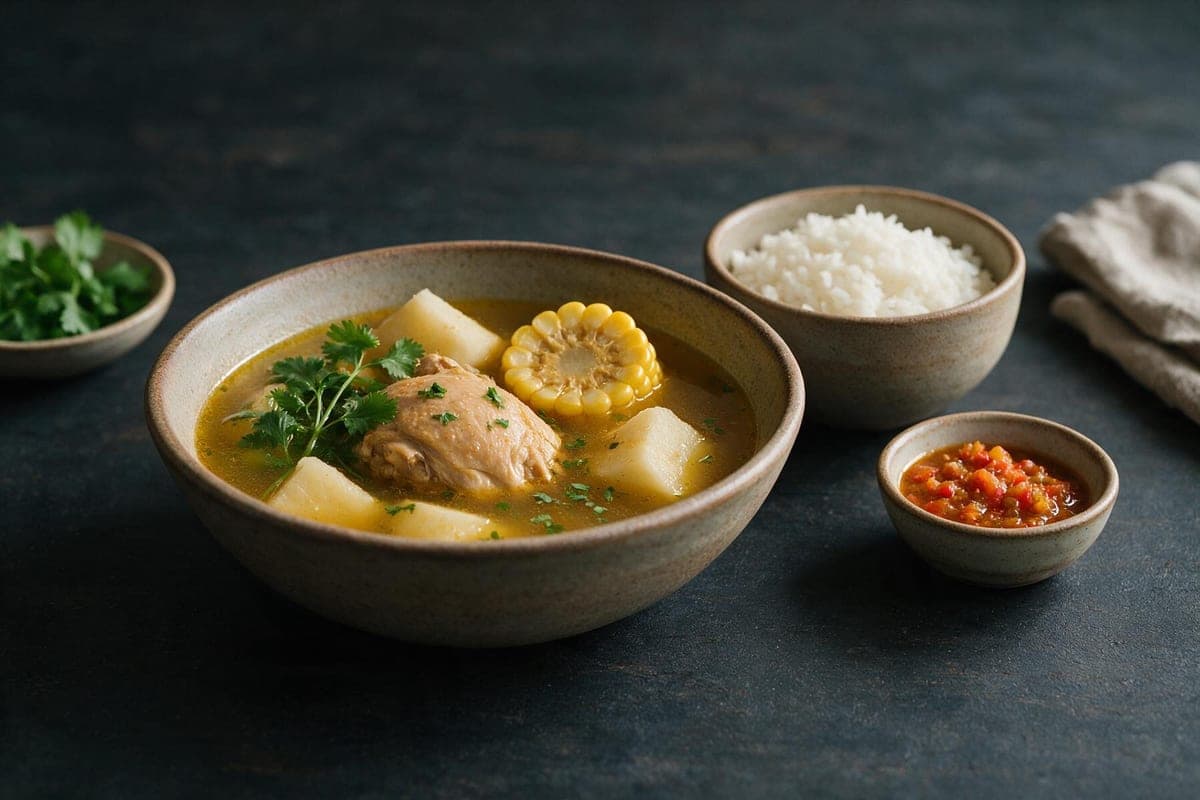
Panama's national soup: chicken simmered with yam, corn and a big handful of culantro until the broth turns golden and herbal, ladled over white rice.

- Prep
- 20 min
- Cook
- 55 min
- Total
- 75 min
- Serves
- 2 adults + 1 child, with a few bowls left over
- Budget
- $15–$22
Panamanian sancocho is a clear, deeply flavored chicken soup rather than a thick stew. Bone-in chicken is simmered with onion, garlic, oregano and culantro, the long-leafed herb that gives the broth its green-gold color and taste, along with chunks of ñame (a starchy tropical yam) that thicken the soup slightly, and rounds of corn on the cob. It is served in deep bowls with white rice on the side, which each person spoons into the soup or eats alongside. It is simple, restorative food, and the dish Panamanians name first.
Why it's on our list
Panama is the hinge between two continents and I want its food on our map with the dish the country itself calls national, not a canal-zone import. Sancocho is a lesson in how much flavor a soup can get from one herb: culantro is stronger and more savory than cilantro, and learning to use it is the point of this dinner. It is weeknight-feasible because it is one pot that mostly looks after itself, and the only knife work is a few vegetables. It is also entirely mild, so my son's bowl is the same as ours, and soup over rice is about as approachable as a new cuisine gets.
Field notes · Origin & culture
Sancocho is a family of meat-and-root-vegetable stews found across the Spanish-speaking Caribbean and northern South America, with roots in Spanish and Canary Island cocidos and West African one-pot cooking. Panama's version, sancocho de gallina, is widely regarded as the national dish and is associated most strongly with the interior provinces, where it was traditionally made with a tough free-range hen (gallina de patio) that needed long simmering. Its defining ingredients are chicken, ñame and culantro; yuca, otoe (a taro relative) and corn are common additions, and the sancocho chiricano of Chiriquí adds squash for a yellower broth. It is eaten at family lunches, as a restorative after a late night, and at celebrations, and it is often described in Panama as a metaphor for the country's mixed heritage. White rice on the side is nearly universal.
Noteworthy ingredients
- Culantro: Also called recao or sawtooth coriander, a long, serrated-leaf herb with a flavor like concentrated cilantro. Latin and Asian markets carry it (ngò gai in Vietnamese groceries). Substitute a whole bunch of cilantro, stems included.
- Ñame: A white-fleshed tropical yam with rough brown skin, sold at Latin and Caribbean markets. It thickens the broth as it cooks. Yuca (fresh or frozen) is the nearest substitute; russet potato works in a pinch but makes a plainer soup.
- Bone-in chicken: Thighs and drumsticks give the broth body in under an hour; a whole cut-up chicken is traditional. Remove the skin for a lighter soup.
- Corn on the cob: Cut into 2-inch rounds and simmered in the soup, it sweetens the broth. Frozen cob pieces are fine.
Prep — 20 min
- Pat the chicken dry and season with 1 teaspoon salt, pepper and the oregano. Remove the skin if you prefer a leaner broth.
- Dice the onion and smash the garlic. Chop about 6 culantro leaves and leave the rest whole for the pot; if using cilantro, tie half the bunch with string so you can fish it out.
- Peel the ñame with a sturdy knife (it is slippery; a towel helps) and cut into 1 1/2-inch chunks. Keep them in water so they do not discolor. Cut the corn into 2-inch rounds.
- Rinse the rice; it starts when the soup has 25 minutes to go.
Cook — 55 min
- Heat the oil in a large pot over medium-high heat. Brown the chicken lightly, 3 minutes per side; you want some color, not a crust. Add the onion and garlic and stir 2 minutes.
- Add 8 cups water, the whole culantro leaves (or the tied cilantro) and the bouillon cube if using. Bring to a boil, skim any foam, then lower to a gentle simmer, cover partially, and cook 20 minutes.
- Add the ñame and simmer 15 minutes. Add the corn and simmer 10–15 minutes more, until the ñame is tender and the chicken is falling off the bone. Mash a few pieces of ñame into the broth to thicken it slightly if you like.
- Meanwhile, cook the rice: 1 1/2 cups rice, 2 1/4 cups water, 1/2 teaspoon salt, covered on low for 18 minutes and rested 5.
- Remove the spent culantro leaves or cilantro bundle. Stir in the chopped culantro and a handful of chopped cilantro. Taste carefully for salt, since the broth is the whole dish, and add a squeeze of lime.
Serving
Ladle the soup into deep bowls, giving everyone a piece of chicken, a few chunks of ñame and a round of corn, and put the rice in a bowl in the middle of the table so each person can add a spoonful or eat it beside. Hot sauce (Panamanians often use a homemade picante of ají chombo, a habanero-type chile) stays on the table for the adults; the pot itself has no heat at all, so my son's bowl needs nothing left out, and the corn round gives him something to pick up. Leftovers improve overnight; the ñame thickens the broth as it sits, so loosen with a little water when reheating.