Dinner night · Solomon Islands
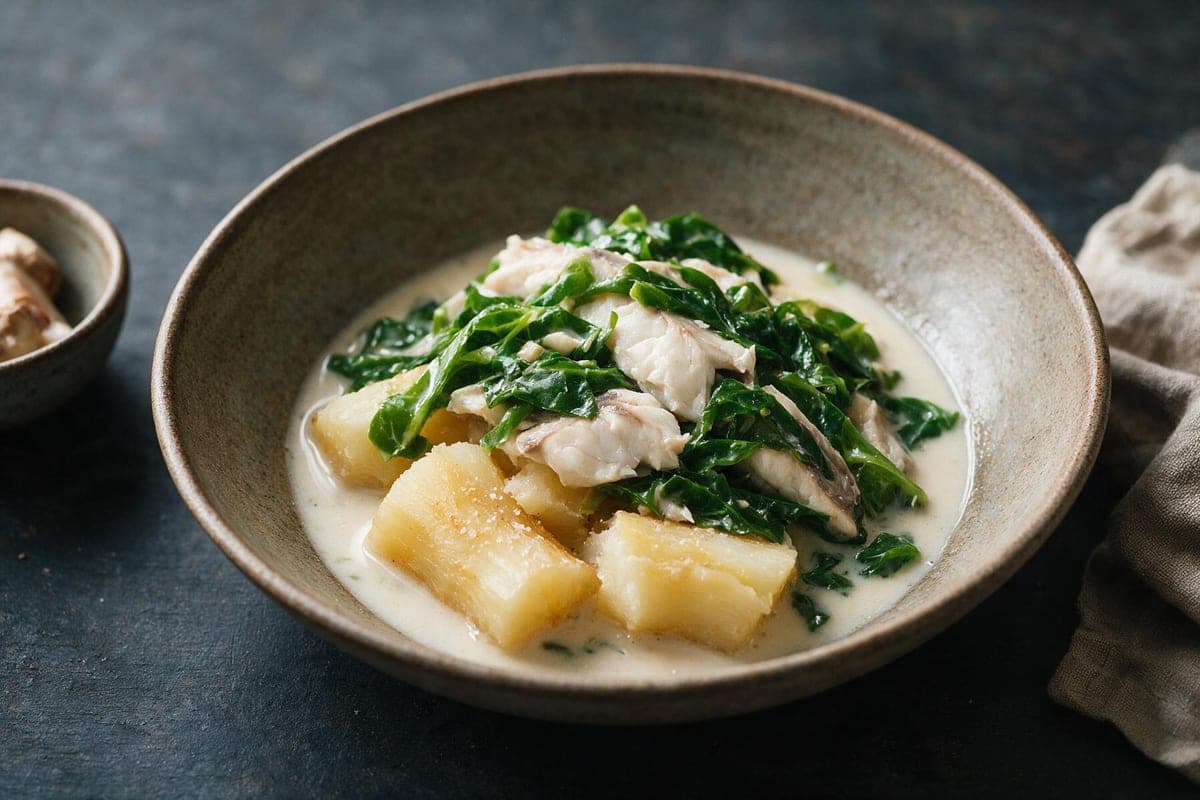
Coconut-poached Fish with Cassava and Greens
A Solomon Islands-style everyday dinner: white fish simmered gently in coconut milk with ginger, garlic, tomato and lime, with boiled cassava and slippery-cabbage-style greens in the same creamy broth.

- Prep
- 20 min
- Cook
- 35 min
- Total
- 55 min
- Serves
- 2 adults + 1 child
- Budget
- $20–$32
Fish is the daily protein of the Solomon Islands, and the most ordinary way to cook it is also one of the gentlest: chunks of white fish simmered in coconut milk with onion, garlic, ginger and tomato, finished with lime. The greens go into the same pot at the end, soaking up the broth the way slippery cabbage does in Solomon kitchens, and boiled cassava comes alongside to mop everything up. Creamy and soothing, with a little heat if you want it, and on the table in under an hour. This is a home-style adaptation using supermarket fish and chard; the swaps are named.
Why it's on our list
I want a fish dinner that does not depend on a hot pan and perfect timing. Poaching in coconut milk is forgiving: the fish cooks in minutes, and a minute long is still moist. Coconut, ginger and lime already work at our table, so the new things to learn are cassava, which we have never cooked, and greens cooked soft in milk instead of crisp. It is weeknight-feasible because cassava boils while you build the broth, and the fish needs ten minutes at the end. The chile stays in a dish on the table so my son's bowl stays mild.
Field notes · Origin & culture
The Solomon Islands sit east of Papua New Guinea, and their cooking is Melanesian at its core: fish and shellfish from the reef, coconut, and root crops, especially cassava and sweet potato, with taro, yam and breadfruit. Fish is the primary meat; pork and chicken are for feasts. Greens, including the leafy hibiscus relative called slippery cabbage for the texture it takes on when cooked, are usually simmered in coconut milk. For celebrations, food is wrapped in leaves and cooked over hot stones in a motu, the stone oven, for hours; a weekday meal is more likely boiled or simmered on a stove or fire. Rice is now a staple in Honiara and other towns. This recipe follows the everyday logic (fish, coconut milk, greens, cassava) rather than any single named dish; Solomon Islanders cook it many ways.
Noteworthy ingredients
- Firm white fish: Snapper is the closest match to a reef fish; cod, halibut, mahi-mahi or tilapia work. Thick fillets hold together better in the broth. Frozen is fine.
- Cassava (yuca): Fresh in the produce section of large supermarkets and all Latin and Asian markets, or frozen peeled chunks, which skip the peeling. Boiled cassava is dense, starchy and slightly sweet. Substitute: steamed rice, also true to a Honiara dinner.
- Full-fat canned coconut milk: Two cans for a generous broth. Do not use the beverage carton.
- Slippery cabbage stand-in: Swiss chard is the best supermarket substitute for texture; spinach or bok choy work. Asian markets sometimes carry the real thing labeled "bele" or "aibika."
- Chile: A small red chile, sliced, is common but optional. Keep it on the side for a mild version.
Prep — 20 min
- If using fresh cassava, peel off the thick waxy skin with a knife, cut into 3-inch lengths, halve lengthwise and pull out the woody center string. Frozen chunks are ready as they are.
- Put the cassava in a pot with cold water to cover by 2 inches and 1 teaspoon salt. Set it on the stove ready to go.
- Cut the fish into 2-inch chunks. Toss with the juice of 1 lime and 1/2 teaspoon salt and let sit in the fridge while you cook the aromatics.
- Thinly slice the onion. Mince the garlic and grate the ginger. Dice the tomatoes. Slice the scallions and, if using, the chile; keep the chile separate.
- Strip chard leaves from the stems; slice stems 1/2 inch thick and tear leaves into large pieces.
Cook — 35 min
- Bring the cassava to a boil, then simmer 20–25 minutes until completely tender and splitting at the edges. Drain and keep warm in the pot with the lid on.
- Meanwhile, heat oil in a wide deep skillet over medium heat. Cook the onion with a pinch of salt for 5 minutes until soft. Add garlic, ginger and chard stems; cook 2 minutes.
- Add the tomatoes and cook 3 minutes, until they start to break down.
- Pour in both cans of coconut milk and 1/2 cup water. Add 1 teaspoon salt and bring to a gentle simmer. Let it bubble quietly for 5 minutes to thicken slightly.
- Add the chard leaves and stir until wilted into the broth, about 2 minutes.
- Nestle the fish chunks into the broth in a single layer, spooning some liquid over them. Cover and simmer gently, never boiling hard, for 7–9 minutes until the fish is opaque and flakes at a touch.
- Take off the heat. Add the juice of 1 lime and taste; it will probably want more salt and maybe more lime. Add chile now only if everyone wants it.
Serving
Put a few pieces of warm cassava in each wide bowl with a pinch of salt, then ladle fish, greens and plenty of coconut broth over them. Top with scallions and cilantro and set lime wedges and sliced chile on the table. For a mild plate, serve fish and broth with no chile and fewer greens; the broth is sweet and gentle. Leftover broth and greens keep 2 days and are good over rice; the fish is best eaten the same night, though it reheats acceptably if warmed slowly in its broth.