Draft preview — not yet published
Dinner night · South Korea — Chuncheon
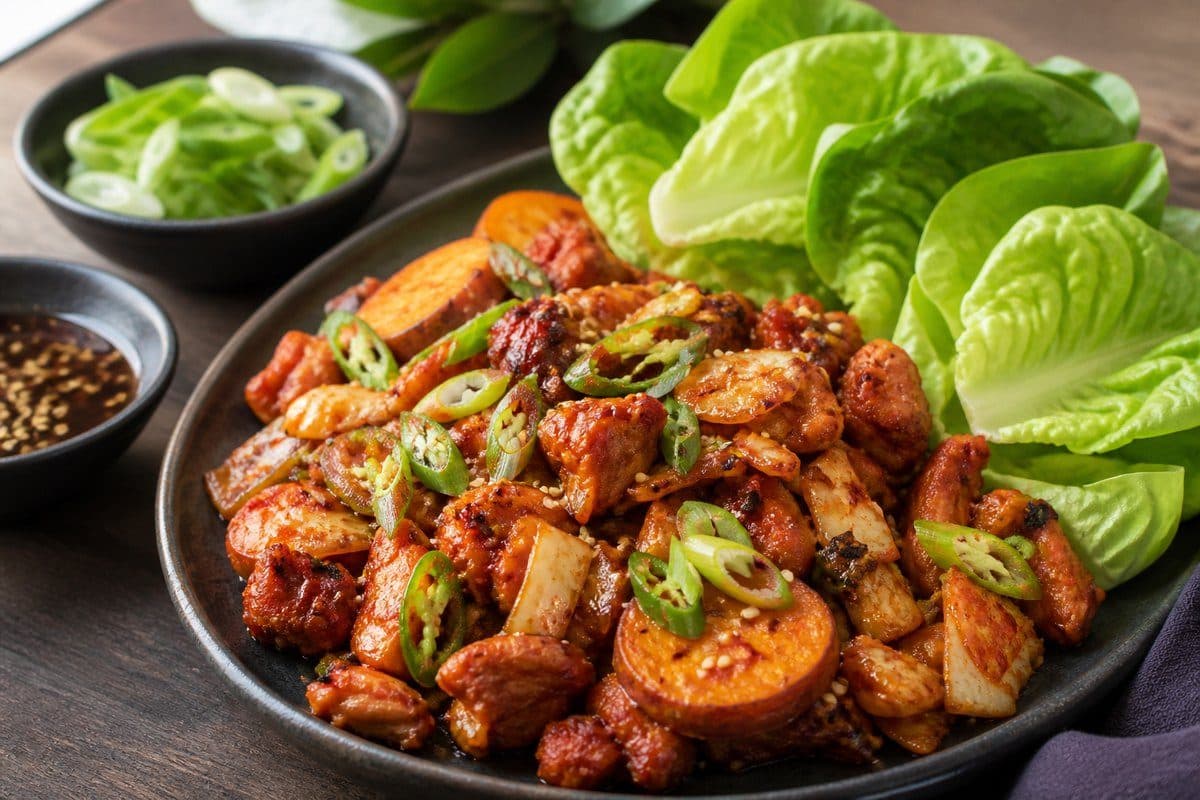
Dak-Galbi Lettuce Wraps
Spicy-sweet Korean chicken, cabbage, and sweet potato tucked into cool, crisp lettuce cups.
- Prep
- 25 min
- Cook
- 20 min
- Total
- 60 min
- Serves
- 2, with a little leftover filling
- Budget
- $24–$34
Dak-galbi is a bold Korean stir-fry of marinated chicken and vegetables in a gochujang-and-gochugaru sauce. This family-sized version includes cabbage and sweet potato, with optional rice cakes, then serves the sizzling mixture in lettuce leaves. The result balances savory heat, caramelized edges, chewy vegetables, and fresh crunch.
Why we love it
The wraps make dinner interactive and let each person control heat and toppings, fitting the brief's high-fun, low-to-medium-energy mood. Tony can add extra gochugaru or hot sauce at the table, while the child's portion can be cooked with a milder amount of sauce and wrapped with rice for balance.
Field notes · Origin & culture
Dak-galbi is strongly associated with Chuncheon in South Korea's Gangwon region. Despite the word “galbi,” which often refers to ribs, the modern dish commonly uses boneless chicken cooked on a large tabletop griddle with cabbage, sweet potato, perilla leaves, and sometimes rice cakes. Restaurants often finish the remaining sauce and bits with fried rice; lettuce wraps are a practical serving adaptation rather than the only traditional presentation.
Noteworthy ingredients
- Gochujang: Fermented Korean chile paste; H Mart has the best selection, while Walmart or Whole Foods may stock it. For a milder dish, use less rather than substituting a sweet generic chili sauce.
- Gochugaru: Korean red-pepper flakes from H Mart. Substitute Aleppo pepper for moderate heat, or omit from the child's portion.
- Tteok (Korean rice cakes): Optional, available refrigerated or frozen at H Mart. Substitute extra sweet potato or cooked short-grain rice.
- Yuja marmalade/tea concentrate: H Mart; it contains preserved citron peel and makes both drink versions. Orange marmalade plus fresh lemon is a workable substitute.
Prep — 25 min
- Cut chicken thighs into 1-inch pieces.
- Whisk gochujang, gochugaru, soy sauce, rice vinegar, honey, sesame oil, garlic, and ginger in a bowl. For a mild child's serving, reserve a few chicken pieces and coat them with 1 teaspoon soy sauce, 1 teaspoon honey, and a drop of sesame oil instead.
- Coat the remaining chicken in the red sauce and marinate for 15 minutes if time allows.
- Chop the cabbage into 1-inch pieces. Thinly slice the onion and scallions. Cut the sweet potato into thin half-moons so it cooks quickly.
- If using frozen or firm rice cakes, soak them in warm water for 10 minutes and drain.
- Wash and dry the lettuce leaves; slice the cucumber into sticks.
Cook — 20 min
- Heat neutral oil in a large skillet over medium-high heat. Cook the mild reserved chicken first until browned and cooked to 165°F; transfer to a clean plate.
- Add the marinated chicken and onion to the skillet. Cook for 4–5 minutes, stirring, until the chicken begins to brown.
- Add sweet potato with 1/4 cup water. Cover, reduce heat to medium, and cook for 6–7 minutes.
- Add cabbage and optional rice cakes. Stir well, cover, and cook for 5 minutes more, adding a splash of water if the sauce catches.
- Uncover and stir-fry for 2–3 minutes until the sauce is glossy, the chicken reaches 165°F, the sweet potato is tender, and the rice cakes are chewy.
- Fold in most of the scallions. Sprinkle with sesame seeds and the reserved scallion tops.
Serving
Place the skillet filling, lettuce leaves, cucumber, and optional rice in the center of the table. Spoon small portions into lettuce cups; rice and cucumber cool the spice. Serve the mild chicken separately for the child and offer gochugaru or hot sauce only at the table. Refrigerate leftover filling for up to 3 days; reheat in a skillet with a spoonful of water, or chop it and fry it with rice.