Dinner night · Suriname
Pom-style Chicken Casserole
Suriname's party dish made weeknight-sized: braised chicken baked between layers of grated malanga root sharpened with orange juice and lime, until the top is crusty and the inside is tangy and soft. About 90 minutes, mostly oven.
- Prep
- 30 min
- Cook
- 60 min
- Total
- 90 min
- Serves
- 2 adults + 1 child, with a square left for a broodje pom tomorrow
- Budget
- $14–$22
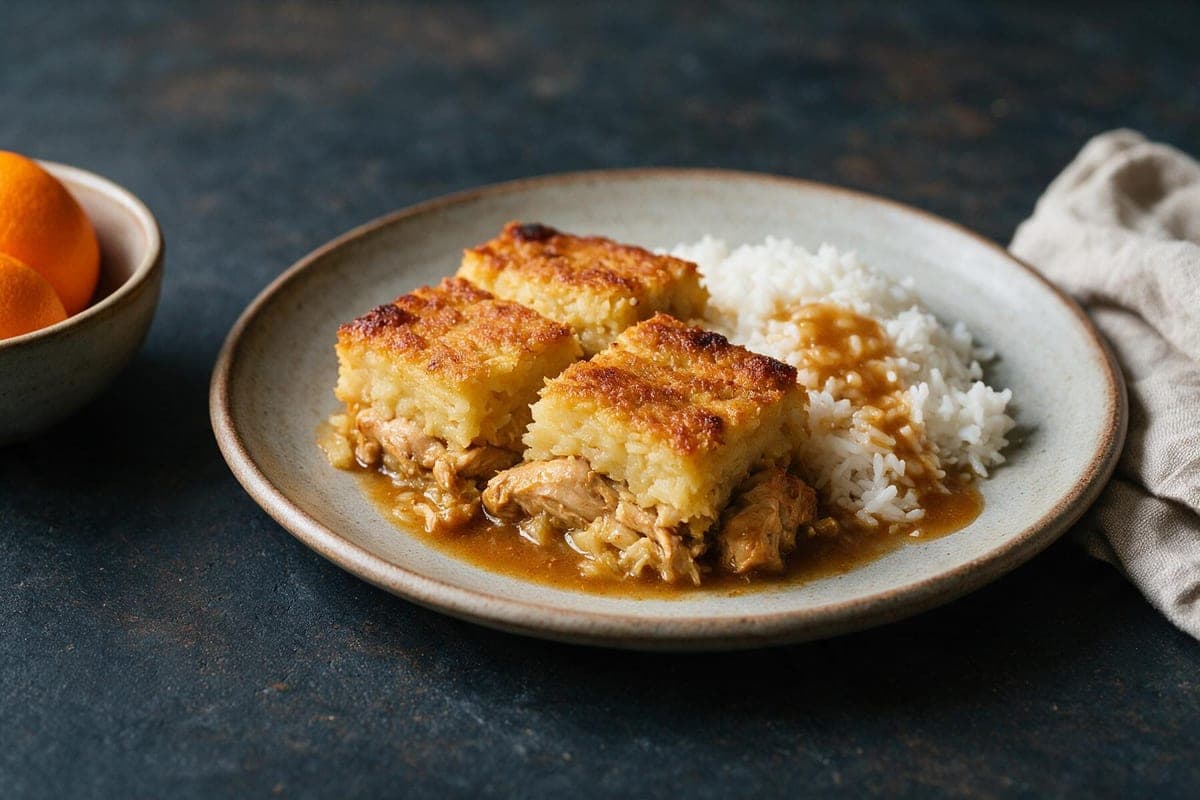
Pom is a baked casserole in which chicken, braised with onion, tomato, celery and nutmeg, is sandwiched between layers of grated pomtajer, a starchy root, mixed with orange juice, lime, a spoon of sugar and the chicken's own gravy. In the oven the root sets into something between a savory pudding and a stuffing, bright with citrus underneath and crusty on top. It is cut into squares and eaten with rice, or stuffed into a soft roll as a broodje pom. There is no heat unless a whole Madame Jeanette pepper is laid on top for aroma.
Why it's on our list
Suriname's food is a little-known mix of Creole, Javanese, Hindustani, Chinese and Dutch cooking, and pom is the dish every Surinamese person names as the taste of home. I want to learn what a grated-root casserole does in the oven, and the orange-juice-and-root combination is unlike anything else on our map. Honest adaptation: traditional pom bakes for an hour and a half or more in a deep dish; this version spreads it thinner so it is done in an hour, and it can be assembled a day ahead. It is mild throughout, so my son's square is the same as ours.
Field notes · Origin & culture
Pom is often called the most popular festive dish in Suriname and in the Surinamese community in the Netherlands, served at birthdays and holidays. Its origin is usually described as Creole or Jewish, and the common account connects the two: Portuguese-Jewish planters in colonial Suriname are said to have made a baked potato-and-chicken dish for the Sabbath, and because potatoes had to be imported, cooks replaced them with the grated root of the tayer plant; the name is thought to come from pomme de terre. That story is widely repeated but not fully documented. The dish appears in the Encyclopaedie van Nederlandsch West-Indië (1914–1917) as grated tayer treated with bitter orange juice and baked with chicken or fish. Today the broodje pom, pom on a soft bun, is a snack-bar classic in Paramaribo and Amsterdam alike.
Noteworthy ingredients
- Malanga or yautía (for pomtajer): Pomtajer is the root of Xanthosoma, sold in US Latin markets as malanga or yautía, so that is the one to look for. Taro is the fallback and behaves similarly. Grated sweet potato works but makes a sweeter, softer dish; if you use it, cut the sugar. Peel with a knife and grate finely.
- Orange and lime juice: Surinamese cooks use bitter (Seville) orange juice when they can get it; regular orange juice plus fresh lime gets close. The acid flavors the root and keeps it from turning grey.
- Nutmeg and celery leaves: The quiet seasonings that make pom taste Surinamese.
- Madame Jeanette pepper (optional): A yellow Surinamese chile close to a habanero, laid whole on top for aroma and removed before serving. Leave it out and nothing is lost but perfume.
Prep — 30 min
- Cut the chicken into 2-inch chunks and season with 1 teaspoon salt and black pepper.
- Dice the onion and two celery stalks. Mince the garlic. Chop the tomatoes and a handful of celery leaves.
- Juice the oranges (about 1 cup) and the limes.
- Peel the malanga and grate finely. Immediately toss it in a large bowl with the orange juice, half the lime juice, the sugar and 1 teaspoon salt so it does not discolor. It will look wet and loose; that is correct.
- Heat the oven to 400°F and oil the baking dish.
Cook — 60 min
- Heat 2 tablespoons oil in the Dutch oven over medium-high heat. Brown the chicken in two batches, 3 minutes per side, and move to a plate.
- Lower the heat to medium, add the onion and celery with a pinch of salt and cook 5 minutes. Add the garlic and tomato paste and stir 1 minute. Add the tomatoes, nutmeg, allspice, celery leaves and 1 cup water.
- Return the chicken, bring to a simmer, cover and cook 15 minutes. Uncover and simmer 5 minutes more to thicken the gravy. Taste for salt. Lift the chicken out; keep the gravy.
- Stir about 3/4 cup of the gravy into the grated malanga with the remaining lime juice. Taste: it should be clearly tangy, lightly salted and only faintly sweet.
- Spread half the malanga in the baking dish, lay the chicken over it with a spoon of gravy, and cover with the rest, smoothing the top. Drizzle with the last tablespoon of oil and add the whole pepper if using.
- Bake 55–60 minutes until the top is deeply golden and crusted at the edges and a knife in the center meets soft, set root rather than wet batter. If assembled ahead and refrigerated, add 10 minutes. Rest 10 minutes before cutting.
- While it bakes, cook the rice (1 1/2 cups rice, 2 1/4 cups water, pinch of salt) and rewarm the leftover gravy for the table.
Serving
Cut the pom into generous squares and lift them onto plates beside a scoop of white rice, with the extra gravy spooned over the rice. A Surinamese table would often add a quick cucumber-and-vinegar salad (zuur). Nothing is spicy; remove the whole pepper before serving and give it to whichever adult wants to crush it onto their own square. Pom is better the next day: a cold square tucked into a soft roll with a little hot sauce is the broodje pom. It keeps three days and reheats, covered, in a 350°F oven for 20 minutes.