Dinner night · Uganda
Ugandan Rolex
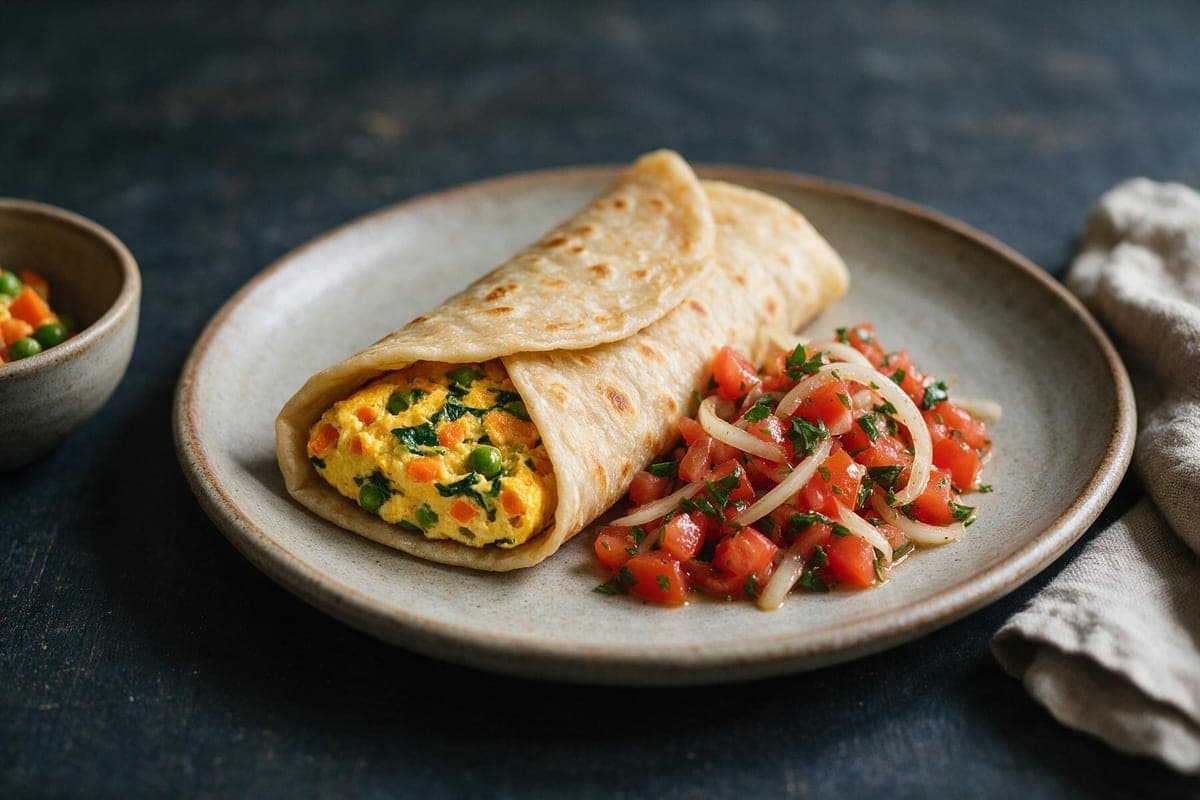
Kampala's favorite street food, a vegetable omelette rolled inside a soft chapati, with a sharp tomato-onion salad: eggs for dinner, done in 35 minutes.

- Prep
- 15 min
- Cook
- 20 min
- Total
- 35 min
- Serves
- 2 adults + 1 child; one rolex each, plus a half for whoever is hungriest
- Budget
- $8–$14
A rolex has nothing to do with watches: the name is a Ugandan play on "rolled eggs." It is a thin omelette, beaten with chopped tomato, onion and shredded cabbage, cooked flat in a skillet, laid onto a warm chapati and rolled up tight. The chapati is soft and a little flaky, the egg is savory and full of vegetables, and the whole thing is eaten by hand. In Uganda it is cooked to order at roadside stands for about a quarter; at home it is the fastest real dinner on our map.
Why it's on our list
We needed an egg dinner, we needed something under 40 minutes, and we needed a dish that children in another country actually love, and the rolex is all three. What I want to learn is the Ugandan-style chapati, softer and more layered than an Indian one, made with a little oil folded into the dough; it will be a useful bread for a lot of East African nights. With homemade chapati dinner is 35 minutes, and with store-bought flour tortillas it is barely 20. It is naturally mild, so my son can have exactly what we have, and the chile goes into the adult salad only.
Field notes · Origin & culture
The rolex is a Ugandan invention of the last few decades. By most accounts it started with a chapati seller in the Busoga region of eastern Uganda and then took off in Wandegeya, the neighborhood beside Makerere University in Kampala, where students adopted it as the cheapest filling meal going; the name comes from "rolled eggs." Chapati itself arrived in East Africa with South Asian traders and workers and is now thoroughly Ugandan. The rolex is sold at stands across the country at any hour, with variations like the kikomando (chopped chapati with beans) and larger multi-chapati versions, and Kampala has celebrated it with an annual Rolex Festival since the mid-2010s. It has become something of a national symbol, and when wheat and oil prices spiked in 2022 the cost of a rolex made the news.
Noteworthy ingredients
- Chapati: Ugandan street chapati is made from flour, water, salt, a little oil and sometimes an egg or grated carrot, rolled thin and fried in a lightly oiled pan until blistered. I give a quick version below. Store-bought substitutes: fresh flour tortillas (burrito size), frozen parathas from an Indian grocer, or packaged chapati/roti.
- Cabbage: Finely shredded raw cabbage goes into the egg and gives it a sweet crunch; a bag of coleslaw mix saves the chopping.
- Tomato and onion: Both inside the egg and raw in the salad. A squeeze of lime and a pinch of salt is all the salad needs.
Prep — 15 min
- Chapati dough (skip if using store-bought): mix 2 cups flour, 1/2 teaspoon salt, 1 egg, 1 tablespoon oil and about 2/3 cup warm water into a soft dough. Knead 3–4 minutes until smooth, then rest, covered, 10 minutes while you prep the vegetables.
- Dice 2 tomatoes and half the onion finely for the eggs. Slice the remaining tomato and onion thin for the salad; toss them with lime juice, salt, chopped cilantro and the sliced chile (adult portion only) and set aside.
- Shred the cabbage very fine if it is not already.
- Beat the 6 eggs in a bowl with 1/2 teaspoon salt and pepper. Stir in the diced tomato, onion and about 1 1/2 cups of the cabbage.
Cook — 20 min
- Chapati: divide the rested dough into 4 balls. Roll each one thin, brush lightly with oil, roll it up into a rope, coil the rope into a snail and flatten; then roll again into a 9-inch round. (This is what gives Ugandan chapati its layers.) Cook each in a lightly oiled skillet over medium-high heat, about 1 1/2 minutes per side, until spotted brown and puffed in places. Stack under a towel.
- Wipe the skillet, add 1 teaspoon oil over medium heat, and pour in a third of the egg mixture (about 2 eggs' worth), spreading the vegetables evenly. Cook 2 minutes until the bottom is set and the top is nearly dry.
- Lay a chapati directly on top of the omelette, press lightly, and after 30 seconds flip the whole thing so the chapati is on the bottom and the egg is on top. Cook 30 seconds more.
- Slide onto a plate. Lay a few slices of tomato and onion (and avocado if using) across the egg, roll up tightly from one side, and wrap the bottom half in parchment or foil if you want to eat it by hand.
- Repeat for the remaining two rolexes. If you are making a half for the hungriest person, cook the remaining egg in the same way on a half-chapati.
Serving
Serve each rolex whole or cut in half on the diagonal, with the tomato-onion salad on the side and ketchup or hot sauce on the table, which is how Ugandan stands do it. My son's rolex is identical to ours, with the chile left out of his salad. A rolex is best eaten within ten minutes of rolling, so I would cook them one after another and eat as they come. Leftover chapati keep two days wrapped at room temperature and reheat in a dry skillet; leftover egg mixture should be cooked the same night.