Dinner night · United Kingdom
Oven Fish and Chips with Mushy Peas
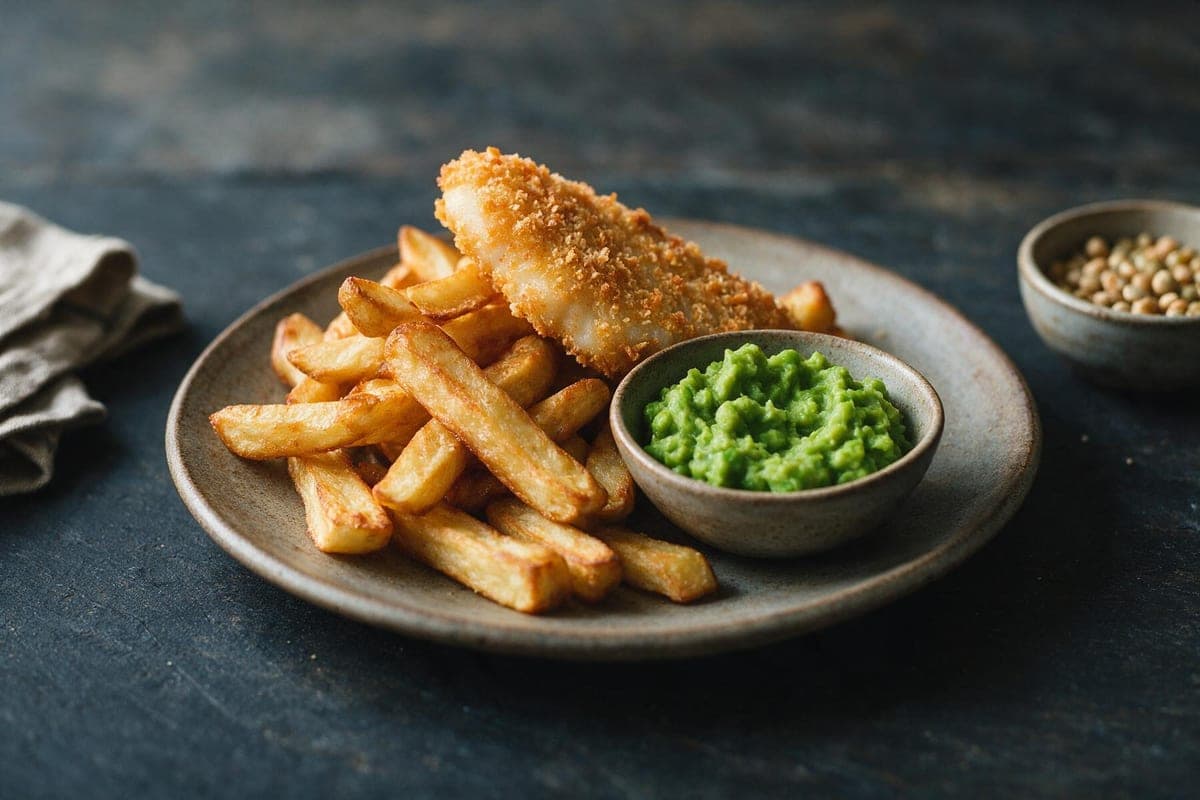
Crisp-crumbed cod, oven chips and a bowl of buttery mushy peas: Britain's Friday-night takeaway, rebuilt for a home oven and a weeknight budget.
- Prep
- 20 min
- Cook
- 35 min
- Total
- 55 min
- Serves
- 2 adults + 1 child
- Budget
- $16–$24
Fish and chips is Britain's great working-class supper: a slab of white fish in a crackling coat, a heap of chips (thick-cut fries, to an American), and, in much of England, a ladle of soft green mushy peas on the side. The real thing is deep-fried in a shop that has been doing it for a century; this version does not pretend to be that. The cod gets a panko-and-cornflake crust that bakes to a real crunch, the chips roast on a second sheet pan, and the peas are a ten-minute saucepan job. Malt vinegar on the table is not optional.
Why it's on our list
Our map has a lot of chicken on it and almost no fish, and this is the most approachable fish dinner I can think of: cod is sold everywhere, the technique is "bread it and bake it," and the sides are potatoes and peas. I want to learn whether an oven crust can get close enough to the fryer that nobody misses the oil, and whether marrowfat peas really taste different from the frozen peas I'd otherwise mash. It is also one of the few dinners where the drink and dessert are as famous as the plate: a Pimm's Cup and an Eton mess make it an English summer evening.
Field notes · Origin & culture
Fried fish in batter is generally traced to Sephardic Jewish communities in London, who fried fish in oil so it could be eaten cold on the Sabbath; a recipe for "fried fish, Jewish fashion" appears in Alexis Soyer's 1845 cookbook. Chipped fried potatoes came from the industrial north and from London, and when the two met in the 1860s the fish-and-chip shop was born. Who opened the first one is contested: a Joseph Malin in London's East End around 1860 and a John Lees in Mossley, Lancashire, around 1863 both have claims. Mushy peas, made from dried marrowfat peas, are a northern English tradition that only became a standard chip-shop side in the later twentieth century. Fish and chips were famously never rationed during the Second World War.
Noteworthy ingredients
- Cod or haddock: Thick, firm fillets hold up to baking. Frozen cod, thawed overnight and patted very dry, is fine and usually cheaper than the fresh counter. Pollock or hake work too.
- Marrowfat peas: These are mature dried peas and the authentic base for mushy peas. Look for Batchelors or a British import brand online or at a British specialty shop; they need an overnight soak. Frozen peas, simmered and mashed with butter and mint, are an honest weeknight stand-in and what I'd use the first time.
- Panko and cornflakes: The crust. Crushed cornflakes add the shattering quality a batter would have given; plain panko alone comes out a little soft.
- Malt vinegar: Sold in the vinegar aisle of most US supermarkets. It is the flavor that makes the whole plate taste British; white vinegar is sharper and not the same.
Prep — 20 min
- If using marrowfat peas, soak them overnight in plenty of water with 1/2 teaspoon baking soda; drain and rinse before cooking. Skip this if using frozen peas.
- Heat the oven to 425°F with one rack in the upper third and one in the lower third.
- Scrub the potatoes and cut them into chips about 1/2 inch thick. Soak in cold water for 10 minutes while you do the rest, then drain and dry thoroughly on a towel; wet potatoes steam instead of crisping.
- Set up three shallow bowls: flour seasoned with 1/2 teaspoon salt, pepper and the paprika; eggs beaten with a tablespoon of water; panko mixed with the cornflakes crushed by hand to coarse crumbs and 1/2 teaspoon salt.
- Cut the fish into 3 portions (or 4 smaller ones so there is a child-size piece). Pat completely dry and season lightly with salt.
- Bread the fish: flour, then egg, then press firmly into the crumb mix on all sides. Lay the pieces on a wire rack set over a sheet pan, or directly on a lightly oiled sheet pan. Drizzle or brush the tops with a tablespoon of oil.
Cook — 35 min
- Toss the dried chips with 2 tablespoons oil and 1/2 teaspoon salt on a sheet pan in a single layer. Roast on the lower rack for 20 minutes.
- Flip the chips, move them to the upper rack, and slide the fish onto the lower rack. Bake both for 15 minutes, until the fish crust is deep golden and the fish flakes at the thickest point (145°F) and the chips are browned and crisp at the edges. If the chips need another 5 minutes, pull the fish and let them go alone.
- Meanwhile make the peas. Marrowfat peas: cover the soaked peas with fresh water by an inch, bring to a boil, then simmer 20–30 minutes until they collapse into a soft green mush, stirring and adding splashes of water if they catch. Frozen peas: simmer in a cup of salted water for 5 minutes, drain most of the water, and crush with a potato masher.
- Finish the peas with the butter, a good pinch of salt, pepper and the chopped mint if using. They should be spoonable, not soupy.
- Cut the lemon into wedges. Put the malt vinegar, salt and ketchup or tartar sauce on the table.
Serving
Pile chips on each plate, lean the fish against them, and spoon the peas alongside so they stay their own thing. Everyone salts and vinegars their own; I'll show my son how a few drops of malt vinegar on the chips work before he reaches for ketchup, but ketchup is allowed. The plate is naturally mild, so there is nothing to hold back for a child. Leftover fish reheats surprisingly well on a sheet pan at 400°F for 8 minutes; leftover peas become a spread for toast or go into a soup.