Dinner night · Venezuela
Arepas Reina Pepiada
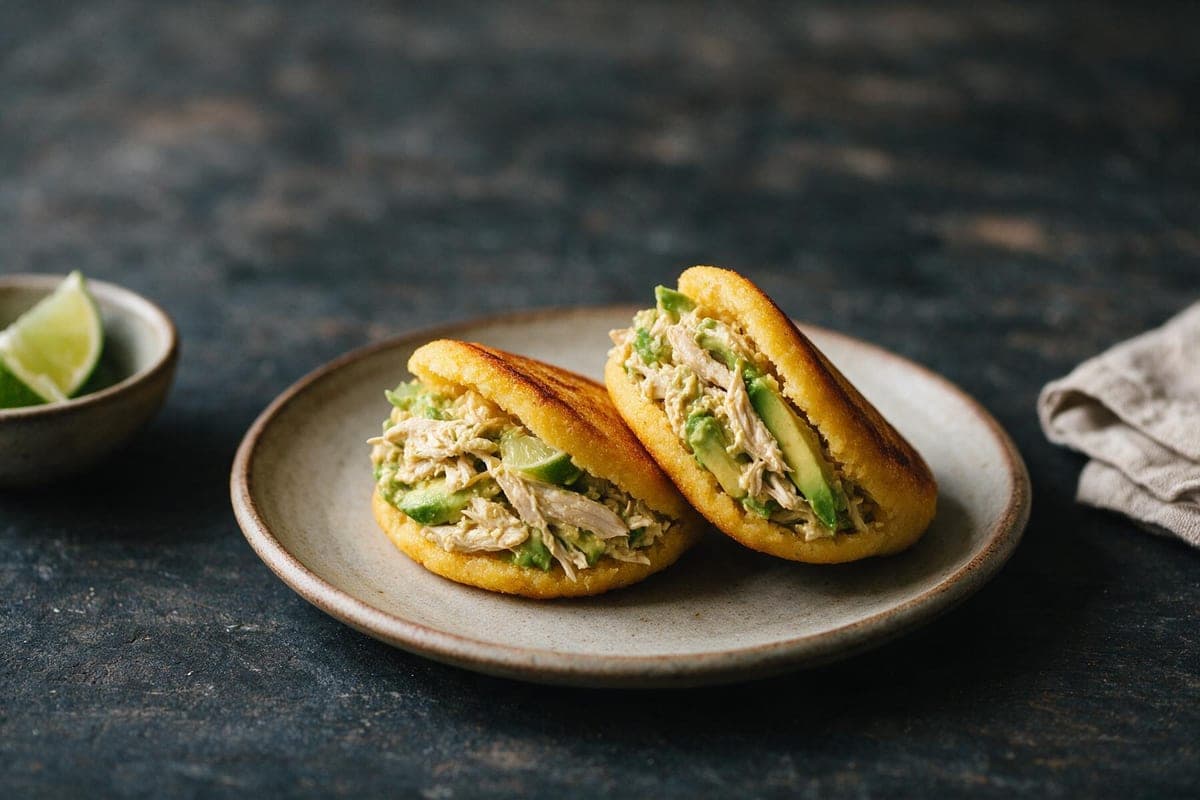
Venezuela's crisp-outside, soft-inside corn cakes split and stuffed with the classic chicken, avocado and lime salad named for a 1955 Miss World: a gluten-free, dairy-free hand-held dinner in 45 minutes.
- Prep
- 20 min
- Cook
- 25 min
- Total
- 45 min
- Serves
- 2 adults + 1 child, 6 arepas
- Budget
- $12–$18
An arepa is a round cake of precooked corn flour and water, patted by hand, griddled until a crisp shell forms, then finished in the oven so the inside steams soft. Split like a pita, it holds almost anything; the reina pepiada filling is poached chicken shredded and folded with mashed avocado, a little mayonnaise, lime, diced onion and cilantro into a cool, creamy salad. The warm, crackly corn shell against the cold green filling is the whole appeal. Nothing is fried or spicy, and the dough is literally flour, water and salt.
Why it's on our list
Arepas are the everyday bread of Venezuela, and I want to learn to make them well enough that they become a format in our kitchen; once you can make the shell, the fillings are endless. The technique I expect to learn is getting the dough hydration right so the arepa is crack-free, and the two-stage cook (griddle, then oven) that produces a crust without a doughy middle. The reina pepiada filling is the most famous one and almost no work. It is weeknight-feasible because the chicken poaches while the dough rests, and rotisserie chicken turns it into a 25-minute dinner. My son's arepa can hold plain chicken, or just cheese, from the same stack.
Field notes · Origin & culture
The arepa is pre-Columbian, with evidence of maize-grinding tools and clay cooking slabs from the region that is now Venezuela and Colombia; the name is usually traced to erepa, the word for corn in the Cumanagoto language of eastern Venezuela. For centuries that meant soaking, grinding and kneading whole corn, until the 1950s, when Venezuelan engineer Luis Caballero Mejías patented a precooked corn flour, commercialized in 1960 as Harina P.A.N., still the brand Venezuelans reach for. The reina pepiada filling was created in Caracas in 1955 by the Álvarez family, who ran an arepera and named their new chicken-and-avocado arepa in honor of Susana Duijm, the first Venezuelan to win Miss World; pepiada was slang of the day for a curvaceous woman. Arepas are central to both Venezuelan and Colombian identity; this is the Venezuelan style, thicker and meant to be split and stuffed.
Noteworthy ingredients
- Precooked white cornmeal (masarepa): Harina P.A.N. is the Venezuelan standard and is in the Hispanic aisle of most US supermarkets; Goya masarepa works the same. It is not masa harina (for tortillas) and not regular cornmeal; the bag will say "precooked." Do not substitute.
- Avocados: Ripe Hass avocados, mashed rather than diced, bind the filling.
- Chicken: Boneless breasts or thighs poached gently with a bay leaf and half an onion, then shredded warm. A rotisserie chicken is a legitimate shortcut.
- Mayonnaise: Just enough to make the salad creamy; some Venezuelan cooks skip it and let the avocado do the work.
Prep — 20 min
- Put the chicken in the saucepan with half the onion, the bay leaf, 1 teaspoon salt and water to cover by an inch. Simmer gently 12–15 minutes until it reaches 165°F. Cool a few minutes in the broth, then shred with two forks. (Skip if using rotisserie chicken.)
- Make the dough: whisk 2 1/2 cups water with 1 teaspoon salt, then stir in 2 1/2 cups masarepa with your hand until there are no dry spots. Rest 5 minutes; it will firm up. It should feel like soft modeling clay and not stick or crack when you press a ball flat. Adjust with water or flour a tablespoon at a time.
- Finely dice the remaining onion half (about 1/4 cup) and chop a handful of cilantro. Juice one lime; cut the other into wedges.
- Mash the avocados with a fork, leaving some texture. Stir in the mayonnaise, lime juice, onion, cilantro, 1/2 teaspoon salt and black pepper.
- Fold in the shredded chicken. Taste; it usually wants more salt and lime than you expect. Refrigerate.
- Heat the oven to 375°F.
Cook — 25 min
- Divide the dough into 6 tennis-ball-sized balls and pat each into a disk about 3 1/2 inches across and 3/4 inch thick, smoothing the edges with a wet finger so they do not crack.
- Heat the skillet or griddle over medium heat and brush with a thin film of oil. Cook the arepas 6–7 minutes per side until a golden-brown crust forms with darker spots; do not rush with high heat or the outside burns before the shell sets.
- Move the arepas to the baking sheet and bake 10–12 minutes. They are done when they sound hollow when tapped; the inside will be soft and steamy.
- Rest 2 minutes, then cut each one most of the way around the edge with a serrated knife, like opening a pita pocket. Some Venezuelans scoop out a little of the soft interior to make room.
- Stuff each arepa generously with the reina pepiada, with a lettuce leaf or tomato slice if you like.
Serving
Serve two arepas per adult and one or two for my son, stuffed to bursting and eaten in the hand; lime wedges and the extra reina pepiada go in the middle. My son's can be a plain chicken arepa with a little mayonnaise, or a cheese arepa (slice the hot shell and tuck in queso fresco so it melts). There is no heat anywhere unless the adults add hot sauce. Leftover filling keeps a day (lime slows the browning). Leftover arepas keep three days and re-crisp in a dry skillet; the dough can also be shaped and refrigerated, uncooked, for tomorrow.