Dinner night · Zambia
Nshima with Ifisashi and Tomato-Braised Chicken
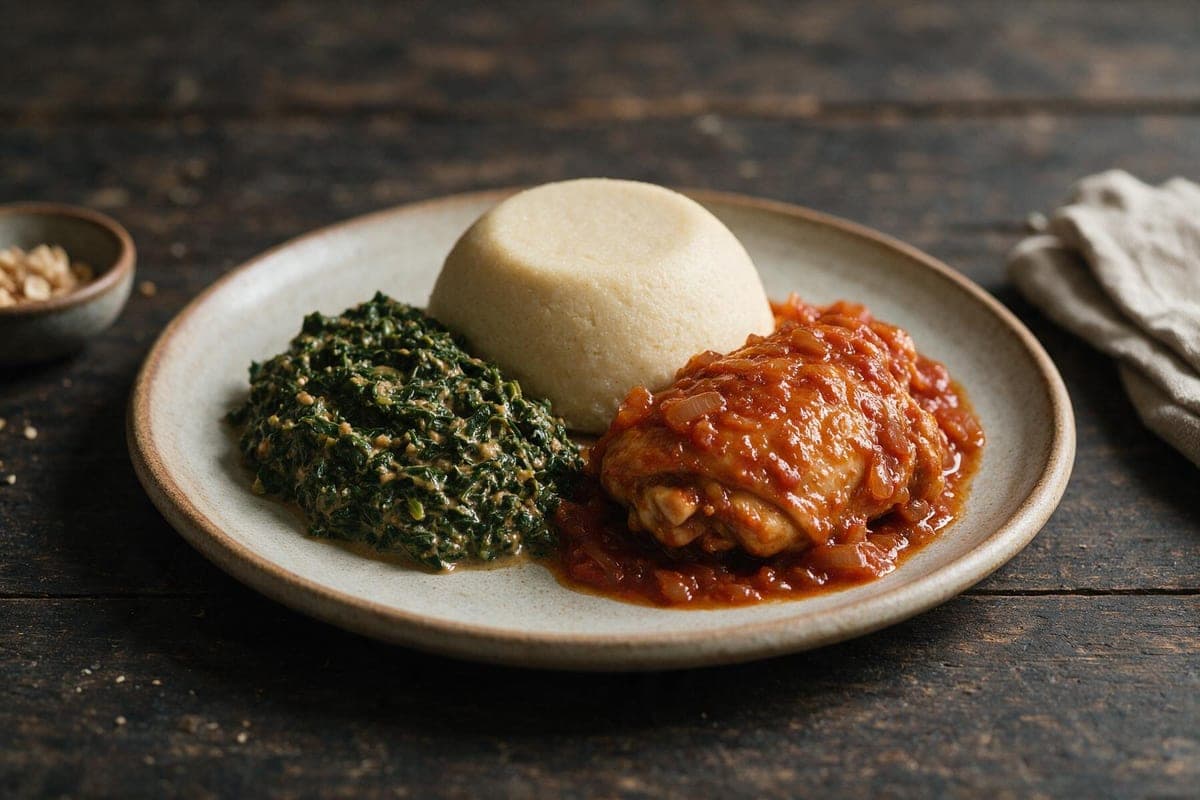
Zambia's everyday plate: smooth maize nshima, greens simmered in a peanut sauce, and a simple pan of chicken in tomato and onion, all eaten by hand.

- Prep
- 15 min
- Cook
- 35 min
- Total
- 50 min
- Serves
- 2 adults + 1 child, with ifisashi left over for lunch
- Budget
- $14–$22
This is a Zambian dinner built the way Zambian dinners are built: a mound of nshima, the stiff white maize porridge that anchors nearly every meal, with two "relishes" beside it. The first is ifisashi, leafy greens cooked down with tomato, onion and ground peanuts until the sauce turns thick and nutty. The second is chicken thighs braised in a plain tomato-and-onion gravy. You pinch off a ball of nshima with your fingers, press a dent into it with your thumb, and use it to scoop up greens and sauce. Nothing here is spicy; the whole plate is about texture and the sweetness of peanuts against bitter greens.
Why it's on our list
I want our map to have the dishes people eat on an ordinary Tuesday, and in Zambia that means nshima with relish. The thing I want to learn is the nshima itself: stirring maize meal into water in two stages until it is smooth and firm enough to hold its shape, which takes a strong arm but no special skill. Ifisashi is the real draw, because greens in peanut sauce is a combination I have never cooked and it turns a bag of collards into something rich. It is weeknight-feasible because the three parts cook at the same time in three pans and the shopping list is short and cheap. Eating with our hands is going to be the selling point for my son.
Field notes · Origin & culture
Nshima is the staple of Zambian cuisine, made from pounded white maize, and it is almost always served with relish: stews, vegetables, beans or fish eaten by hand, traditionally with the right hand. Ifisashi is one of the most common relishes, a stew of greens and peanuts that can be vegetarian or include meat; the greens vary with what is growing, from pumpkin leaves and sweet-potato leaves to rape, cabbage and spinach. Peanuts, called groundnuts across the region, are a key crop, and ground raw peanuts thicken sauces the way cream does elsewhere. Nshima and its cousins, nsima in Malawi, sadza in Zimbabwe, ugali in East Africa, are the same idea with different names and textures.
Noteworthy ingredients
- White cornmeal (fine grind): Zambian mealie meal is finely ground white maize. Fine white cornmeal from the Latin aisle (not masa harina, which is lime-treated) is the closest supermarket match; yellow cornmeal works but changes the color a little.
- Unsalted peanuts: Ifisashi is traditionally made with raw peanuts pounded to a flour. Grinding unsalted peanuts in a food processor gets close; natural, unsweetened peanut butter is a faster substitute that plenty of home cooks use.
- Collard greens or kale: Stand-ins for pumpkin leaves and rape. Spinach works but cooks down to very little, so buy two bunches if you use it.
- Bone-in chicken thighs: "Village chicken" in Zambia is a tougher, free-range bird cooked slowly; supermarket thighs braise in 30 minutes and still give the sauce body.
Prep — 15 min
- Strip the collard leaves from the stems, stack them, roll them and slice into thin ribbons. Rinse well in a bowl of water and drain.
- Dice both onions. Dice the tomatoes. Mince the garlic.
- Grind the peanuts in a food processor or blender in short pulses until they look like coarse flour; stop before they turn to butter. If using peanut butter, measure it out and stir in 1/4 cup warm water so it loosens.
- Pat the chicken dry and season both sides with salt, pepper and the paprika.
- Measure the cornmeal into a bowl and set it by the stove with a 4-cup measure of cold water.
Cook — 35 min
- Chicken. Heat 1 tablespoon oil in the skillet over medium-high. Brown the thighs skin-side down 5–6 minutes until deep golden, turn and brown 2 minutes more. Move to a plate. Add half the onion to the fat and cook 4 minutes, then add the garlic, tomato paste and half the tomatoes. Cook 3 minutes until the tomato breaks down. Return the chicken skin-side up, add 1 cup water or stock, cover partly, and simmer gently 25 minutes until the chicken reaches 165°F and the sauce has thickened.
- Ifisashi. In the heavy saucepan, warm 1 tablespoon oil over medium heat and cook the remaining onion 4 minutes. Add the remaining tomatoes and a pinch of salt and cook 4 minutes until soft. Add the collards and 1/2 cup water, cover, and cook 8 minutes, stirring once, until the leaves are tender. Stir in the ground peanuts (or loosened peanut butter) and cook uncovered 5–8 minutes, stirring often, until the sauce thickens and coats the greens. Season with salt.
- Nshima. While the greens cook, bring 3 cups water to a boil in the second saucepan. Whisk 1 cup cornmeal with 1 cup cold water into a smooth slurry, then pour it into the boiling water, stirring. Lower the heat to medium and cook, stirring, about 8 minutes; it will look like a loose porridge. Now add the remaining cup of dry cornmeal a handful at a time, stirring hard with the wooden spoon after each addition, until the nshima is very thick, smooth and pulls away from the sides of the pan. Cover and let it steam over the lowest heat 3 minutes.
- Taste the chicken sauce and the greens for salt. Squeeze lime over the chicken.
Serving
Wet a large spoon or a small bowl and shape the nshima into smooth mounds, one per plate. Put a generous scoop of ifisashi on one side and a chicken thigh with sauce on the other. Set out a bowl of warm water for rinsing fingers and show everyone the move: pinch, roll, dent, scoop. There is no chile anywhere in this meal, so my son's plate is identical to ours; adults who want heat can add a few drops of hot sauce. Leftover ifisashi keeps three days; leftover nshima firms up in the fridge and pan-fries well in slices.