Dinner night · Zimbabwe
Sadza with Beef Stew and Muriwo
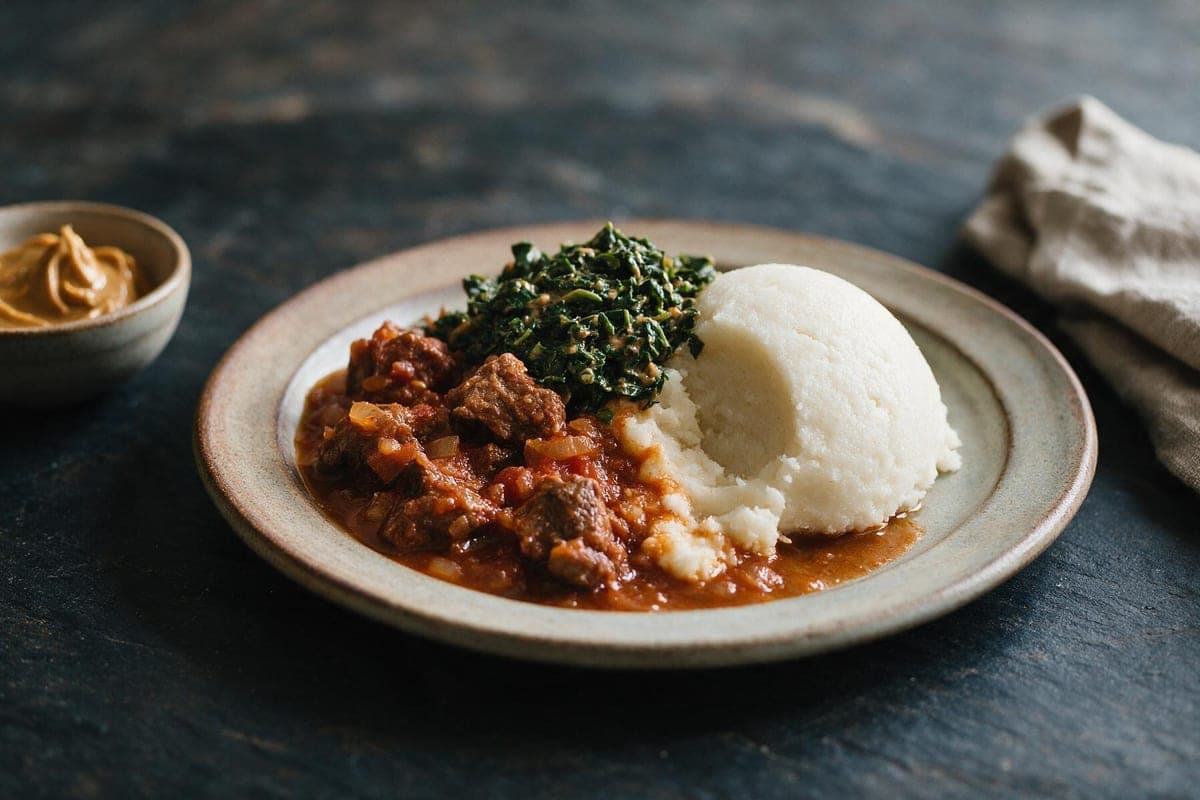
The Zimbabwean plate: stiff white maize porridge, a tomato-onion beef stew (nyama) and greens with peanut butter, cooked side by side in about 75 minutes.

- Prep
- 15 min
- Cook
- 60 min
- Total
- 75 min
- Serves
- 2 adults + 1 child, with stew left over
- Budget
- $15–$24
This is the plate Zimbabweans mean when they say "food": sadza, a thick, smooth, white maize-meal porridge stiff enough to shape with the fingers; nyama, here a beef stew cooked down with onion and tomato until the gravy is rich and brick-red; and muriwo, leafy greens such as covo (a collard-like kale), rape or pumpkin leaves cooked with onion and tomato, here finished with a spoonful of peanut butter to make muriwo unedovi. The seasoning is plain, mostly salt, and the dish is about the gravy soaking into the sadza. Everyone eats with the right hand.
Why it's on our list
Zimbabwe gets talked about for safaris and Victoria Falls, and I want the dinner that is on the table there every night. The technique I want to learn is sadza, cooked in two stages, a thin porridge first and then more meal beaten in until firm, which Zimbabweans judge by smoothness. I also want to try greens with peanut butter, a combination that sounds odd and apparently is not. It is weeknight-feasible on a slightly longer evening: the stew simmers unattended for 50 minutes while the sadza and greens take 25, and there is no heat at all, so my son's plate is identical to ours.
Field notes · Origin & culture
Sadza (the Shona name; Ndebele speakers call it isitshwala) is the staple of Zimbabwe, made from finely ground white maize meal (hupfu in Shona, impuphu in Ndebele). Maize displaced older sorghum and millet porridges and became dominant in the twentieth century; Zimbabweans strongly prefer white maize, and yellow meal is remembered as hardship food. Sadza is eaten with nyama (meat, most often beef, goat or chicken), muriwo (greens; muriwo unedovi is greens with peanut butter), derere (okra) or sour milk. Traditionally it was eaten from a shared bowl; today it is more often plated, but still eaten with the right hand, rolling a lump into a ball and dipping it. "Sadza nenyama" is served everywhere from city canteens to rural homesteads. This is a mainstream home version.
Noteworthy ingredients
- White maize meal: Look for "mealie meal" at African groceries or online (Iwisa, White Star, or a Zimbabwean brand if you find one); fine white cornmeal from the supermarket works with a slightly grainier result. Avoid coarse polenta and masa harina.
- Beef chuck or stewing beef: Bone-in pieces are traditional and add body; boneless chuck in 1-inch cubes is simpler and needs 50 minutes.
- Greens: Collards are the closest supermarket stand-in for covo; kale or chard also work. In Zimbabwe, rape and pumpkin leaves are everyday choices.
- Natural peanut butter (dovi): Unsweetened peanut butter stirred into the greens at the end is a classic Zimbabwean move; skip it for plain muriwo if anyone dislikes peanuts.
- Beef bouillon: A stock cube or soup powder is a common seasoning in Zimbabwean stews and is optional here.
Prep — 15 min
- Pat the beef dry and season with 1 teaspoon salt, black pepper and the paprika.
- Dice the onions and tomatoes; mince the garlic. Set aside half an onion and one tomato for the greens.
- Wash the greens, cut out the thick stems and slice the leaves into thin ribbons.
- Put 4 cups water with 1 teaspoon salt in a heavy saucepan for the sadza, and measure the maize meal.
Cook — 60 min
- Stew: Heat 2 tablespoons oil in a Dutch oven over medium-high. Brown the beef in two batches, 3–4 minutes each, and set aside. Lower heat to medium, add the onion and cook 5 minutes; add the garlic for 1 minute, then the tomato paste for 1 minute. Add the tomatoes and cook 4 minutes until they collapse. Return the beef with 1 1/2 cups water and the bouillon if using, bring to a simmer, cover and cook 50 minutes, stirring occasionally, until the beef is tender and the gravy is thick. Uncover for the last 10 minutes to reduce if needed. Taste for salt.
- Sadza: About 25 minutes before the stew is done, bring the salted water to a boil. Mix 1/2 cup of the maize meal with 1/2 cup cold water into a slurry, stir it into the boiling water and cook, stirring, 5–7 minutes until it thickens to a smooth porridge. Then add the remaining 1 1/2 cups meal a handful at a time, beating hard with a wooden spoon after each addition, until the sadza is stiff, smooth and pulling away from the pot. Lower the heat to the minimum, cover and steam 10 minutes, then beat once more.
- Muriwo: Heat 1 tablespoon oil in a skillet over medium. Cook the reserved onion 4 minutes, add the reserved tomato and cook 3 minutes, then add the greens with a pinch of salt and 1/4 cup water; cover and cook 12–15 minutes, stirring now and then, until tender. Stir in the peanut butter with another splash of water until the greens are coated in a thin, creamy sauce; season with salt and a squeeze of lemon.
Serving
Shape a large scoop of sadza onto each plate with a wet spoon, spoon the beef and plenty of gravy beside it so the gravy runs into the porridge, and add a heap of greens. Eat with the right hand: pinch off a piece of sadza, roll it, press a dent with your thumb and scoop up stew and greens; I plan to let my son lead on this, since the hand method is the fun of the meal. There is no heat to manage. Leftover sadza firms up overnight and can be sliced and fried for breakfast; the stew keeps three days and is better the second day.